
Hilton Head Beach Access: Walkable, Bikeable, Drive-Access, or Not Really Convenient?
Hilton Head Beach Access: Walkable, Bikeable, Drive-Access, or Not Really Convenient?
A lot of Hilton Head buyers hear "near the beach" and fill in the blanks themselves. They assume the walk will be easy, guests can park, bikes will solve the problem, and a beach-area condo will automatically feel convenient once they own it.
Sometimes that is true. Sometimes it is not.
Beach access on Hilton Head is not just a distance question. It is a practical-use question. How do you actually get to the sand? Can you walk there comfortably? Can guests bike there without it becoming a chore? If you have to drive, where do you park during the summer? Is the route public, community-controlled, resort-controlled, or only convenient for certain owners and guests?
That is the part buyers need to understand before they treat every "close to the beach" property the same.
The Big Misunderstanding: Public Beach Does Not Always Mean Easy Access
Hilton Head's beach itself is public, but that does not mean every property has simple public access. The access point, parking setup, community gate, resort policy, walking route, bike route, and guest logistics can completely change how the property lives.
That matters because buyers are not just buying a map location. They are buying a routine.
A condo that is technically close to the ocean may still be frustrating if the walk is awkward, the parking is limited, the route is not obvious, or guests constantly have to figure out where to go. Another property may be farther from the beach but easier to use because the access point, parking, bike path, or shuttle routine is cleaner.
The better question is not simply, "How far is it from the beach?" The better question is, "How does this property actually get me, my guests, or my renters to the beach on a busy summer day?"
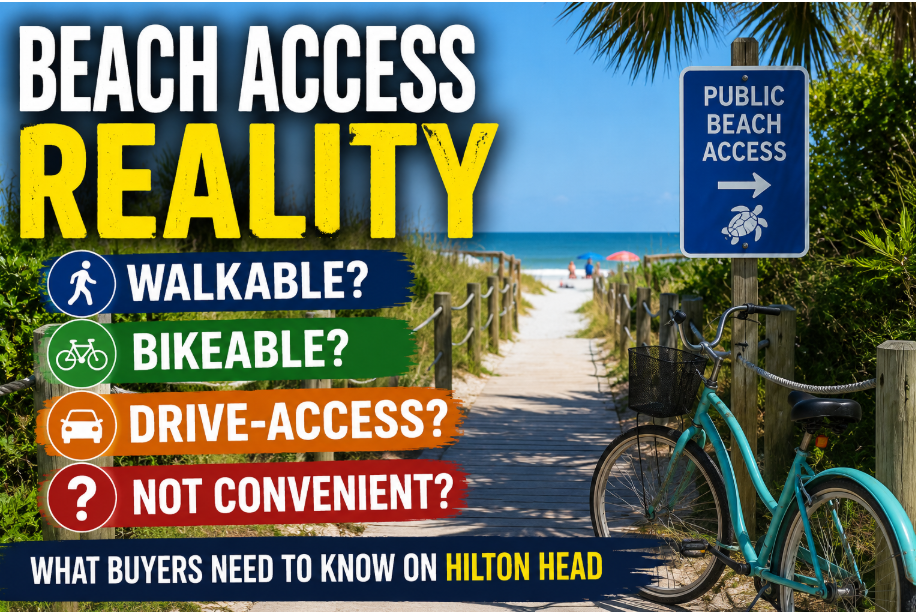
Walkable Beach Access
Walkable beach access is usually the strongest form of convenience, but buyers need to be realistic about what "walkable" means.
A short walk on a listing description may feel very different in July heat while carrying chairs, towels, umbrellas, coolers, beach toys, and everything else people bring for a full beach day. A walk that feels easy for two adults may not feel easy with small children, older guests, or visitors who expect the beach to be effortless.
True walkability is not just mileage. It is the route.
Is there a practical sidewalk or pathway? Are there busy crossings? Is the access point straightforward? Does the property sit near a public beach park, private community path, or resort-controlled access? Are stairs, elevators, parking lots, or internal community routes part of the routine?
This is why two condos that both sound "close to the beach" can feel completely different in real life. One may be an easy grab-a-towel walk. The other may be close on a map but annoying enough that people still end up driving.
Bikeable Beach Access
Hilton Head is one of the better biking islands in the country, and bikeability can be a major advantage for owners, guests, and vacation users. But bikeable does not always mean simple.
Biking works best when the property has a practical pathway connection, easy bike storage, a clear route to the beach, and a beach access point that can handle bikes without creating extra friction. It becomes less useful when guests are carrying a lot of beach gear, traveling with younger children, dealing with road crossings, or trying to coordinate several people at once.
Bikeable access can be a very good middle ground. It may allow a buyer to consider properties that are not directly walkable but still feel connected to the beach. The danger is assuming that because Hilton Head is bike-friendly, every property is equally bike-convenient.
Buyers should look at the exact route, not just the general island reputation.
Drive-Access Beach Convenience
Some Hilton Head properties are not truly walkable or bikeable to the beach, but they can still work if the drive-access routine makes sense.
This is where parking matters. Public beach parks can help a property feel more beach-connected, but parking availability, fees, peak-season demand, and the exact beach park location all affect the experience. A property that depends on driving to the beach may work well for some owners and poorly for others.
This is especially important for buyers who plan to use the property during summer weeks. July beach access is not the same as a quiet weekday in the off-season. A drive that feels easy in March may feel very different when the island is busy, parking is tighter, and guests are trying to coordinate around beach chairs, coolers, and kids.
Drive-access is not automatically bad. It just needs to be understood honestly.
For some buyers, driving to a beach park is perfectly fine because they care more about price, interior condition, view, space, privacy, or lower ownership friction. For other buyers, especially those expecting a true beach-week lifestyle, drive-access may be a disappointment.
Not Really Convenient
This is the category buyers often miss.
A property can look beach-oriented online but still be inconvenient in practice. Maybe the beach route is longer than expected. Maybe the nearest access is private or controlled. Maybe parking is limited. Maybe biking sounds easy but does not work well with guests and gear. Maybe the property is marketed with beach language, but the actual owner routine is not very beach-friendly.
This does not mean the property is bad. It means the buyer needs to understand what they are really buying.
A less convenient beach routine may be acceptable if the price, condition, view, layout, community, fees, and ownership costs make sense. But it should not be priced or evaluated the same way as a property with genuinely easy beach access.
Convenience affects daily use. It affects guest satisfaction. It can affect rental appeal where rentals are allowed. It can also affect resale because future buyers will ask the same question: "How easy is it to get to the beach?"
How Beach Access Affects Condo Buyers
For condo buyers, beach access can change the entire purchase decision.
A buyer comparing Hilton Head condos should not only look at the photos, finishes, and distance to the water. They should compare the real ownership experience. A renovated condo with a difficult beach routine may not feel as strong as a slightly less flashy condo with easier access. A lower-priced condo may not be as attractive once the buyer realizes the beach setup is inconvenient. A higher-priced condo may justify the premium if it solves the beach-access problem cleanly.
This is where buyers need to slow down and think like owners, not browsers.
How will you use the property on a normal beach day? What will guests do? What will renters expect if rental use is allowed? How will older family members get to the beach? Where will bikes go? Where will cars go? Is the access still easy during the busiest weeks of the year?
Those questions matter more than a listing phrase.
How Beach Access Affects Sellers
Sellers also need to be careful with beach-access language.
If the property has strong beach convenience, that should be made clear. But if the access is more complicated, the listing should not oversell it. Buyers usually figure out the real route once they visit, and if the marketing created the wrong expectation, that can work against the seller.
A better approach is to explain the property honestly. If it is walkable, explain the practical route. If it is bikeable, explain why that works. If most people drive, explain the nearest public beach park and the realistic access routine. If the beach is more of a short-trip feature than a true daily convenience, position the property around the things it actually does well.
Good marketing does not need to pretend every Hilton Head property is a beach-front experience. It needs to help the right buyer understand why the property makes sense.
What Buyers Should Verify Before Making an Offer
Before writing an offer on a Hilton Head beach-area property, buyers should verify the exact beach route, who can use the access point, whether guests or renters have the same access, where cars and bikes are supposed to go, and whether any community or regime rules affect the way the property can be used.
Buyers should also look at the route in person when possible. A map can be helpful, but it does not tell the whole story. It does not show how the walk feels in summer heat, how traffic affects crossings, how full the parking lot gets, how easy it is to carry beach gear, or whether the access routine matches the buyer's expectations.
The goal is not to scare buyers away from properties that are not directly walkable. The goal is to understand the tradeoff before paying for it.
The Better Way to Compare Hilton Head Beach Access
Instead of treating beach access as yes or no, buyers should compare it in four practical categories.
Walkable means the beach is easy enough to reach on foot for the way the buyer actually plans to use the property.
Bikeable means the route works well by bike and does not create problems with gear, storage, safety, or guest use.
Drive-access means the beach is reachable by car, but parking, seasonality, and convenience need to be part of the decision.
Not really convenient means the property may have a beach-area label, but the actual route is not strong enough to drive the purchase on its own.
Once buyers think about it this way, the decision becomes much clearer.
Final Takeaway
On Hilton Head, beach access can be one of the biggest reasons a buyer wants a property. It can also be one of the easiest things to misunderstand.
The beach may be close, but the routine still has to work. Walking, biking, driving, parking, guest access, community rules, and seasonal demand all matter.
The best purchase is not always the closest property to the ocean. It is the property where the access, condition, fees, rules, location, and total ownership experience make sense together.
If you are comparing Hilton Head condos, villas, or beach-area properties, do not just ask how close it is to the beach. Ask how the beach actually works from that property.
 FAQ
FAQ
Are Hilton Head beaches public?
Yes, the beach itself is public, but beach access can be public, private, gated, resort-controlled, community-controlled, or limited by parking and logistics. That difference matters a lot when buying a property.
Is walkable beach access always better?
Walkable beach access is usually very valuable, but it still depends on the route, the property, the buyer's use, and the total ownership cost. A truly easy walk can be a major advantage. A technically walkable but awkward route may not feel as strong in real life.
Is biking to the beach practical on Hilton Head?
It can be. Hilton Head has a strong pathway system, and many buyers value bike access. But buyers should still verify the exact route, bike storage, crossings, guest convenience, and how realistic biking is with beach gear.
Does better beach access help resale?
It can, because future buyers often care about the same thing. Easy beach access can make a property more attractive, but resale still depends on the exact property, condition, view, fees, rules, ownership costs, and competing listings.
Should sellers mention beach access in their listing?
Yes, but it should be accurate. If the access is easy, explain it clearly. If it is bikeable or drive-access, describe it honestly. Overselling beach convenience can create the wrong expectation once buyers visit.
Categories
- All Blogs (108)
- Hilton Head Condo Buyer Strategy (7)
- Beach Access & Coastal Ownership (1)
- Bluffton & Lowcountry Living (2)
- Bluffton Buyer / Seller / Comparison Topics (2)
- Bluffton Communities and Relocation (4)
- Bluffton Real Estate (8)
- Bluffton Real Estate / Relocation Guide (2)
- Buyer Advice (1)
- Buyer Guides (1)
- Costs, Fees, Insurance, Financing, and Due Diligence (1)
- Golf / Private Club / Gated Community Living (1)
- Golf / Private Club Communities (1)
- Hilton Head & Bluffton Buyer Strategy (1)
- Hilton Head Area Comparisons (1)
- Hilton Head Communities (4)
- Hilton Head Communities & Area Guides (11)
- Hilton Head Condo Buyer Guide (9)
- Hilton Head Condo Market Updates (1)
- Hilton Head Condo Seller Strategy (1)
- Hilton Head Condos & Villas (14)
- Hilton Head Homes (1)
- Hilton Head Homes + Island Living (2)
- Hilton Head Homes and Island Living (1)
- Hilton Head Real Estate (1)
- Hilton Head Seller Strategy (8)
- Hilton Head Short-Term Rental + Investment Guide (1)
- Hilton Head vs Bluffton (1)
- Hilton Head vs Bluffton / Relocation (3)
- Lowcountry Homeownership (1)
- Market Reports & Trends (4)
- Relocation and Retirement (1)
- Retirement & Relocation (1)
- Retirement and 55+ Communities (1)
- Retirement and Relocation (2)
- Retirement, 55+ & Private Club Living (3)
- Seller Strategy and Valuation (1)
- Short-Term Rentals & Investment (3)
Recent Posts
Should You Buy in Beaufort Instead of Hilton Head or Bluffton?
Hampton Hall vs Hampton Lake: Golf-Centered or Lake-Centered Living?

Multigenerational Living in Bluffton: The Floor Plan Matters More Than the Bedroom Count
Buying a Lowcountry Home With a Private Dock: What Buyers Need to Verify
Selling After You Move Out: Vacant, Staged, or Left Furnished?
Flood Zone, Elevation, and Insurance: Why the House Next Door Can Carry a Different Risk

Septic vs Sewer in Bluffton and the Lowcountry: What Changes for the Buyer?
Buying a Stucco Home in the Lowcountry: What Buyers Should Investigate
Private Pool vs Community Pool: What Bluffton Buyers Are Really Choosing

Buying a Golf-Course Home When You Do Not Actually Golf