Oceanfront vs Oceanside Condos on Hilton Head: Which Lifestyle Fits You Best?
Oceanfront vs Oceanside Condos on Hilton Head: Which Lifestyle Fits You Best?
When people start looking at Hilton Head condos, one of the first questions is usually simple: do I want to be oceanfront, or is oceanside close enough?
That sounds like a small difference, but on Hilton Head, it can change almost everything. It can affect price, view quality, rental appeal, insurance exposure, regime fees, guest convenience, personal use, and even how the property feels when you actually stay there.
The mistake is assuming oceanfront is automatically better for every buyer. It is not. Oceanfront can be incredible for the right person, but oceanside condos can often make more sense depending on lifestyle, budget, rental goals, and how you plan to use the property.
What Oceanfront Really Means
Oceanfront usually means the building or property sits directly along the beach side, with the strongest beach positioning in that area. In the best cases, you are paying for the view, the sound of the ocean, the easiest beach experience, and the emotional pull that comes with being right there.
That matters. Buyers and guests understand oceanfront immediately. It is easy to market, easy to explain, and often easier to remember. For a second-home buyer, waking up to the ocean may be the whole point.
But oceanfront ownership also deserves a deeper look. The closer you are to the beach, the more important it becomes to understand building condition, insurance structure, reserves, flood exposure, exterior maintenance, regime fees, special assessments, and how the building has been maintained over time.
Oceanfront is not just a view. It is a stronger lifestyle position, but usually with more due diligence attached.
What Oceanside Usually Means on Hilton Head
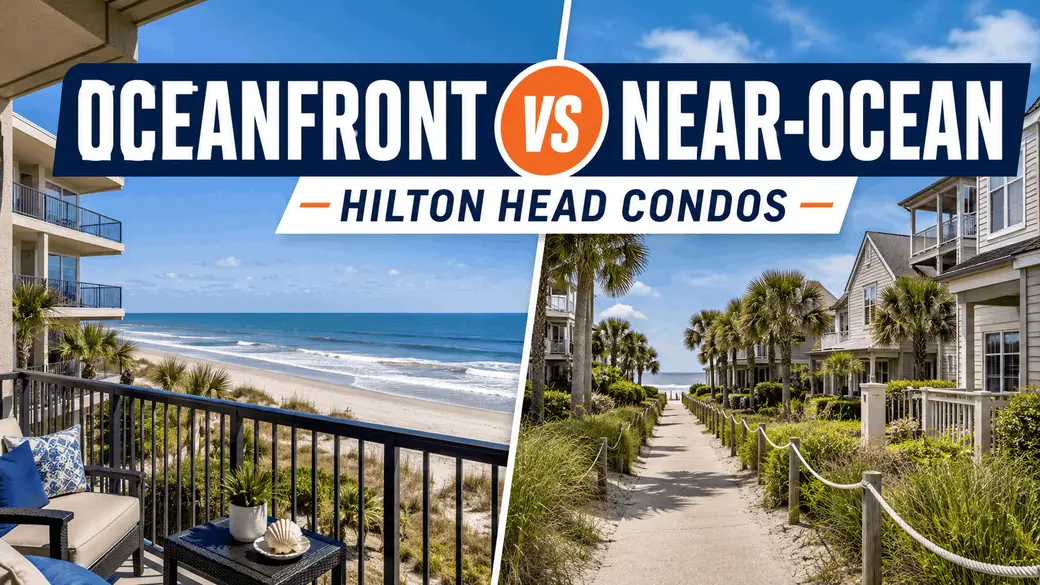
Oceanside is a broader term. It usually means the condo is on the beach side of the island or inside a beach-oriented area, but not necessarily directly oceanfront.
That could mean a short walk to the beach. It could mean across the street. It could mean inside a resort community with beach access nearby. It could mean near-ocean, walk-to-beach, or beach-oriented depending on the exact property.
This is where buyers need to slow down. “Oceanside” can be a great fit, but the actual beach route matters. Is it a simple walk? Is there a controlled access point? Do guests need to cross a road? Is parking involved? Can you realistically carry chairs, coolers, kids’ beach gear, or a wagon?
A good oceanside condo can feel very convenient. A weak oceanside condo can sound better in the listing than it feels in real life.
The Lifestyle Difference
Oceanfront buyers usually want the beach to be the center of the experience. They want the view, the balcony, the sunrise, the sound, and the direct connection to the water. For many of them, the property is not just a place to sleep. It is the destination.
Oceanside buyers may still want strong beach access, but they are often more flexible. They may care more about value, layout, updates, rental numbers, parking, pool access, walkability to restaurants, or being in a specific community like Palmetto Dunes, Sea Pines, Forest Beach, Shipyard, or Folly Field.
That is why this decision is not only about distance to the sand. It is about how you plan to use the condo.
If your ideal Hilton Head day is coffee on the balcony staring at the Atlantic, oceanfront may be hard to beat. If your ideal day is beach in the morning, pool in the afternoon, dinner nearby, and a lower carrying cost, a strong oceanside condo may be the smarter fit.
Rental Appeal: Oceanfront Has Power, But Numbers Still Matter
Oceanfront condos often have a clear rental advantage because guests understand the value quickly. Ocean views, direct beach positioning, and strong photos can help a property stand out.
But that does not mean oceanfront always wins financially.
A higher purchase price, higher regime fee, bigger insurance exposure, upcoming assessments, older building issues, or major renovation needs can reduce the advantage. A well-located oceanside condo with strong updates, good amenities, easy beach access, and lower carrying costs can sometimes make more sense for an investor.
The key is not gross rental income. The key is net performance after regime fees, insurance, property management, repairs, furnishings, cleaning, taxes, permit costs, and downtime.
On Hilton Head, rental rules also need to be verified at multiple levels: Town rules, community rules, condo regime rules, and any property-specific restrictions. Never assume short-term rentals are allowed just because the condo is near the beach.
Ownership Costs and Due Diligence
For both oceanfront and oceanside condos, the regime is part of the product.
That means buyers should review the budget, reserves, master deed, bylaws, insurance coverage, deductibles, maintenance history, capital projects, special assessments, rental rules, pet rules, parking rules, and financing eligibility.
This matters even more near the beach because salt, wind, moisture, storms, exterior maintenance, balconies, roofs, windows, elevators, and structural components can all become expensive over time.
A pretty condo with weak building financials can become a problem. A less dramatic view with a healthier regime and better cost structure may be the better long-term ownership decision.
Which Buyer Fits Oceanfront Best?
Oceanfront tends to fit buyers who want the strongest beach experience and are comfortable paying for it.
It can be a good fit for buyers who want premium personal use, stronger emotional appeal, easier rental marketing, ocean views, direct beach positioning, and long-term scarcity.
It may not be the best fit for buyers who are stretching their budget, trying to maximize net rental return, or uncomfortable with higher carrying costs and coastal building due diligence.
Which Buyer Fits Oceanside Best?
Oceanside tends to fit buyers who want beach access but do not need the most expensive view position.
It can be a smart fit for second-home buyers, value-conscious condo buyers, investors who care about net return, and owners who want flexibility. In many cases, oceanside buyers can get more space, better updates, stronger amenities, or a better overall cost structure than they could get in a true oceanfront unit at the same price.
The tradeoff is that the property has to be marketed and evaluated honestly. “Close to the beach” is not enough. The route, access point, parking, community, condition, and guest experience all need to make sense.
The Bottom Line
Oceanfront is about the strongest beach position. Oceanside is about access, value, and flexibility.
Neither one is automatically better.
The right choice depends on how you plan to use the condo, how important the view is, whether rental income matters, how much due diligence the building requires, and whether the total ownership cost makes sense.
On Hilton Head, the best condo is not always the one closest to the ocean. It is the one that fits your lifestyle, your budget, your risk tolerance, and your long-term ownership plan.
Thinking About Buying or Selling a Hilton Head Condo?
If you are comparing oceanfront and oceanside condos on Hilton Head, I can help you look past the listing language and understand what the property actually offers.
Beach access, view quality, rental rules, regime fees, building condition, insurance, and resale positioning all matter.
Joel Androna
HHI Condo Guy
Real Broker LLC
843-227-4649
joel@joelsells.com
Categories
- All Blogs (108)
- Hilton Head Condo Buyer Strategy (7)
- Beach Access & Coastal Ownership (1)
- Bluffton & Lowcountry Living (2)
- Bluffton Buyer / Seller / Comparison Topics (2)
- Bluffton Communities and Relocation (4)
- Bluffton Real Estate (8)
- Bluffton Real Estate / Relocation Guide (2)
- Buyer Advice (1)
- Buyer Guides (1)
- Costs, Fees, Insurance, Financing, and Due Diligence (1)
- Golf / Private Club / Gated Community Living (1)
- Golf / Private Club Communities (1)
- Hilton Head & Bluffton Buyer Strategy (1)
- Hilton Head Area Comparisons (1)
- Hilton Head Communities (4)
- Hilton Head Communities & Area Guides (11)
- Hilton Head Condo Buyer Guide (9)
- Hilton Head Condo Market Updates (1)
- Hilton Head Condo Seller Strategy (1)
- Hilton Head Condos & Villas (14)
- Hilton Head Homes (1)
- Hilton Head Homes + Island Living (2)
- Hilton Head Homes and Island Living (1)
- Hilton Head Real Estate (1)
- Hilton Head Seller Strategy (8)
- Hilton Head Short-Term Rental + Investment Guide (1)
- Hilton Head vs Bluffton (1)
- Hilton Head vs Bluffton / Relocation (3)
- Lowcountry Homeownership (1)
- Market Reports & Trends (4)
- Relocation and Retirement (1)
- Retirement & Relocation (1)
- Retirement and 55+ Communities (1)
- Retirement and Relocation (2)
- Retirement, 55+ & Private Club Living (3)
- Seller Strategy and Valuation (1)
- Short-Term Rentals & Investment (3)
Recent Posts