The Biggest Red Flags in Older Hilton Head Condo Buildings
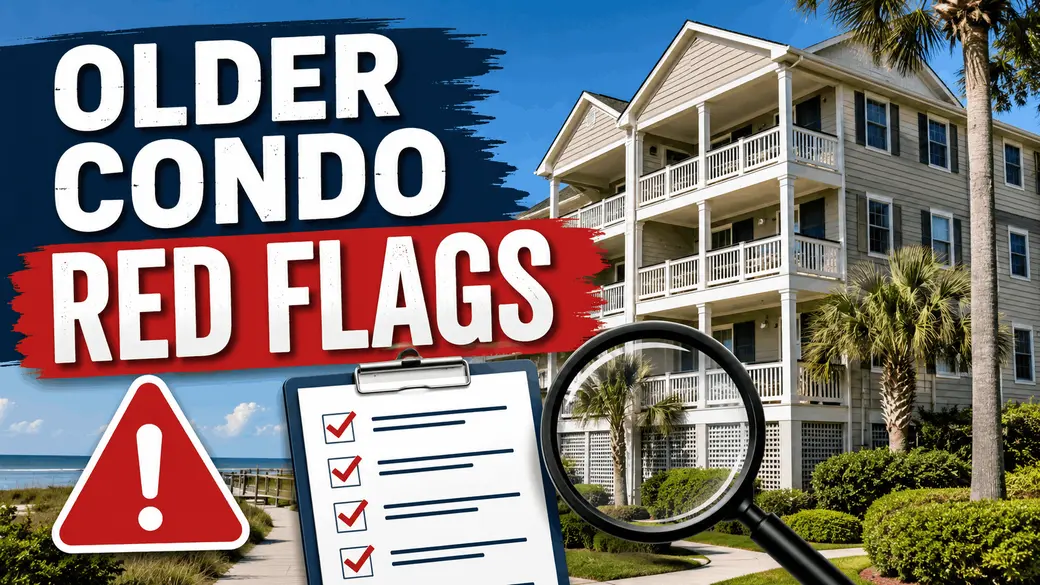
The Biggest Red Flags in Older Hilton Head Condo Buildings
Older Hilton Head condo buildings can be some of the best real estate on the island.
That may sound strange at first, but it is true. Many of Hilton Head’s older condo and villa communities sit in locations that would be very hard to recreate today: oceanfront, near-ocean, walk-to-beach, close to Coligny, inside Sea Pines, inside Palmetto Dunes, in Folly Field, in Shipyard, or tucked into long-established resort areas.
So the issue is not automatically age.
The real question is whether the building has been maintained, funded, insured, and managed in a way that gives buyers confidence.
That is where the red flags show up.
A dated kitchen is one type of issue. A building with weak reserves, unclear insurance, pending repairs, poor documentation, special assessments, or financing concerns is a much bigger conversation.
Older Does Not Automatically Mean Bad
This is the first thing Hilton Head condo buyers need to understand: older does not automatically mean bad.
Some older Hilton Head condo buildings are in excellent locations. They may have strong owner demand, good maintenance history, reasonable fees, clear rules, and a realistic plan for future work. For the right buyer, those properties can still be very attractive.
But older buildings require better questions.
A newer condo buyer still needs to review the regime documents, insurance, rules, fees, and building condition. With older beach-area buildings, that review matters even more because the property may have decades of exposure to salt air, storms, exterior maintenance cycles, roof work, balcony repairs, elevator updates, pool repairs, parking repairs, rental wear and tear, and insurance changes.
That does not mean buyers should run away.
It means they should slow down and understand the building before they fall in love with the unit.
Red Flag #1: Deferred Maintenance With No Clear Plan
Deferred maintenance is one of the biggest red flags in older Hilton Head condo buildings.
The issue is not that something needs work. Buildings need work. Roofs age. Elevators need service. Exterior siding, stucco, railings, decks, balconies, stairways, windows, doors, drainage systems, and waterproofing all have life cycles.
The real problem is when the building needs work and no one can clearly explain what is being done, when it will happen, or how it will be paid for.
That is when buyers should slow down.
If there are obvious exterior issues, aging balconies, water staining, worn common areas, repeated repair patches, or major projects that keep getting pushed off, the buyer needs to understand what is happening.
A beautiful unit inside a poorly maintained building can still become a problem. When you buy a Hilton Head condo, you are not only buying the furniture, view, kitchen, or rental history.
You are buying into the building.
Red Flag #2: Regime Fees That Look Too Low
Buyers love low monthly fees.
I understand why.
But in older Hilton Head condo buildings, a low regime fee is not automatically a good thing.
Sometimes a lower fee means the building is efficiently managed. Other times, it means the association has not been collecting enough money to properly fund insurance, reserves, repairs, maintenance, or future capital projects.
That difference matters.
A regime fee should be judged by what it includes, what it excludes, what the building needs, and whether the association is planning for the future. A cheap monthly fee can become very expensive later if the building has to make up the difference through a special assessment.
For Hilton Head condo buyers, the better question is not:
“Is the monthly fee low?”
The better question is:
“Does this fee make sense for this building?”
Red Flag #3: Weak Reserves or No Recent Reserve Study
Reserves are one of the least exciting parts of buying a condo.
They are also one of the most important.
A reserve fund is money set aside for future building needs. That can include roof replacement, exterior repairs, painting, elevator work, pool improvements, structural maintenance, parking repairs, drainage work, and other larger projects that do not happen every month but eventually have to be paid for.
In older Hilton Head condo buildings, reserves matter because time eventually catches up with every building.
If a building does not have meaningful reserves, does not have a recent reserve study, or cannot explain how future capital projects will be handled, that should slow the buyer down.
It does not always kill the deal.
But it should lead to better questions before the buyer gets too emotionally attached.
A renovated condo in a weak regime can still carry risk. A dated condo in a well-funded, well-managed regime may be stronger than it looks.
Red Flag #4: Special Assessments With No Context
A special assessment is not automatically a deal killer.
That needs to be said clearly.
Sometimes an assessment is part of responsible ownership. A building may need a roof, exterior repairs, elevator updates, painting, drainage work, insurance-gap funding, or another major project. If the regime has a clear plan, the work is defined, the cost is known, and everyone understands the payment schedule, the assessment may be manageable.
The red flag is not simply the word “assessment.”
The red flag is confusion.
Buyers should ask:
- What is the assessment for?
- Has it already been approved?
- Is it only being discussed?
- How much is owed for this unit?
- Who pays it at closing?
- Is it a one-time assessment or part of a pattern?
- Is the work already complete?
- Are there bids, reports, permits, timelines, or warranties?
- Could another assessment be coming?
- Does the lender have any concerns about it?
An assessment that solves a known issue is one thing.
An assessment that points to years of underfunding, insurance pressure, or unclear building problems is another.
Red Flag #5: Insurance That Is Not Clearly Understood
Insurance is one of the biggest ownership-cost issues in coastal condo markets.
That is especially true on Hilton Head.
Buyers need to understand the master policy, wind and hail coverage, flood exposure, deductibles, what the regime covers, and what the individual owner needs to insure separately.
This is not just paperwork. Insurance can affect monthly ownership cost, buyer confidence, lender approval, future assessments, resale, and long-term affordability.
A buyer should not wait until the last minute to understand insurance.
Questions to ask include:
- What does the master insurance policy cover?
- What are the deductibles?
- Is flood insurance included, separate, or owner-specific?
- What does the buyer need for interior coverage?
- Has the premium recently increased?
- Is another increase expected?
- Are there insurance-related assessments?
- Will the lender accept the master policy?
- How does the deductible get handled if there is a claim?
On Hilton Head, insurance is not a side issue.
It is part of the ownership math.
Red Flag #6: Financing Problems With the Building
Some buyers think condo financing is only about their credit score, income, and down payment.
That is not true.
The building matters too.
A lender may review the condo project itself. That review can include the budget, insurance, reserves, litigation, owner delinquency, investor concentration, special assessments, building condition, and whether there are unresolved repairs.
So even if the buyer is financially strong, the building can still create financing problems.
This is why Hilton Head condo buyers should talk to a lender early, especially if the building is older, oceanfront, heavily rented, under assessment, involved in litigation, or dealing with recent insurance changes.
A good buyer with the wrong lender or the wrong loan program can lose time fast.
For older Hilton Head condo buildings, the financing question should come up early, not three days before closing.
Red Flag #7: Rental Income Being Used to Ignore Building Risk
This happens often with Hilton Head vacation condos.
A buyer sees rental numbers and starts focusing only on income.
That is risky.
Rental income matters, especially in areas like Forest Beach, Folly Field, Palmetto Dunes, Sea Pines, Shipyard, and other vacation-oriented condo markets. But rental income does not erase building risk.
A condo can have strong bookings and still have high regime fees, weak reserves, major insurance increases, pending assessments, rental restrictions, financing challenges, building maintenance issues, flood or wind exposure, guest-wear concerns, or future capital projects.
A rental spreadsheet is not a substitute for due diligence.
Buyers need to understand gross income, net income, management costs, cleaning, repairs, furnishings, utilities, insurance, taxes, regime fees, permit requirements, and building health.
On Hilton Head, a condo is not just a rental unit.
It is part of a regime.
That regime can protect the value, or it can become the reason buyers hesitate later.
Red Flag #8: Oceanfront Location Distracting From Building Condition
Oceanfront and near-ocean condos on Hilton Head can be extremely attractive.
The view, beach access, guest appeal, and long-term scarcity are real.
But a strong location should not make buyers ignore building condition.
Older oceanfront buildings can face more exposure from salt air, wind, moisture, storms, water intrusion, exterior wear, balcony issues, aging windows and doors, roof cycles, drainage problems, and insurance pressure.
That does not mean buyers should avoid oceanfront condos.
It means they should take the building seriously.
The beach is the lifestyle.
The building is the responsibility.
You need to understand both.
What Buyers Should Request Before Buying an Older Hilton Head Condo
Before buying an older Hilton Head condo, buyers should try to review as much building and regime information as possible.
Useful items may include:
- Current regime budget
- Current balance sheet
- Reserve study, if available
- Reserve account balances
- Master insurance declarations
- Flood insurance information, if applicable
- Wind and hail coverage details
- Insurance deductibles
- Recent board meeting minutes
- Current or pending special assessments
- Past special assessments
- Litigation or claim information
- Engineering or inspection reports, if available
- Completed capital projects
- Planned capital projects
- Roof, elevator, exterior, balcony, stair, pool, parking, and drainage maintenance history
- Rental rules
- Pet rules
- Parking rules
- Owner vs guest access rules
- Regime documents and bylaws
- Condo questionnaire
- Lender project review feedback
- Flood zone and insurance implications
- Current active competition in the same building or area
This is not about being difficult.
It is about buying with your eyes open.
The best older Hilton Head condo purchases usually happen when the buyer understands both sides of the deal: the lifestyle benefit and the ownership responsibility.
What This Means for Sellers
Sellers should take this seriously too.
If you own an older Hilton Head condo and plan to sell, buyers are going to ask harder questions than they did a few years ago.
That does not mean your condo is a problem.
It means your listing needs cleaner documentation and clearer positioning.
If the building has a strong reserve position, make that clear. If an assessment has already been paid, say so. If major work has been completed, document it. If the regime has handled insurance increases responsibly, help the buyer understand that.
If the unit has updates, good rental history, strong location, and clean building documentation, that can separate it from other listings.
But if the buyer has to guess, they may assume the worst.
In the older condo market, clarity creates confidence.
Bottom Line
Older Hilton Head condo buildings are not automatically risky.
Some of them are in the best locations on the island.
But buyers need to look past the view, furniture, rental history, and list price.
The real question is simple:
Does the building make sense?
A smart Hilton Head condo buyer should understand the regime fees, reserves, insurance, assessments, financing, rental rules, maintenance history, and building condition before making a final decision.
That is especially true for beach-area and oceanfront condo buildings.
The right older condo can still be a great fit.
The wrong one can surprise you after closing.
And on Hilton Head, surprises are usually more expensive than questions.
FAQ: Older Hilton Head Condo Buildings
Are older Hilton Head condos a bad idea?
No. Older Hilton Head condos are not automatically a bad idea. Some are in excellent locations with strong beach access, rental appeal, and long-term resale interest. The key is reviewing the building condition, regime finances, reserves, insurance, assessments, and rules before buying.
What is the biggest red flag in an older condo building?
The biggest red flag is not age by itself. It is uncertainty. Weak reserves, vague maintenance plans, unresolved repairs, special assessments with no explanation, insurance issues, or lender concerns can all create risk.
Should buyers avoid condos with special assessments?
Not always. A special assessment can be part of a responsible repair or improvement plan. Buyers should understand what the assessment is for, whether it has been approved, how much is owed, who pays it, whether the work is complete, and whether more costs could be coming.
Can condo building issues affect financing?
Yes. Condo financing can depend on the building, not just the buyer. Lenders may review insurance, reserves, litigation, delinquency, building condition, special assessments, and other project-level details before approving a loan.
What documents should I review before buying an older Hilton Head condo?
Buyers should review the regime budget, reserves, insurance declarations, meeting minutes, assessment history, governing documents, rental rules, pet rules, parking rules, flood information, maintenance history, and lender-required condo questionnaire whenever available.
Categories
- All Blogs (108)
- Hilton Head Condo Buyer Strategy (7)
- Beach Access & Coastal Ownership (1)
- Bluffton & Lowcountry Living (2)
- Bluffton Buyer / Seller / Comparison Topics (2)
- Bluffton Communities and Relocation (4)
- Bluffton Real Estate (8)
- Bluffton Real Estate / Relocation Guide (2)
- Buyer Advice (1)
- Buyer Guides (1)
- Costs, Fees, Insurance, Financing, and Due Diligence (1)
- Golf / Private Club / Gated Community Living (1)
- Golf / Private Club Communities (1)
- Hilton Head & Bluffton Buyer Strategy (1)
- Hilton Head Area Comparisons (1)
- Hilton Head Communities (4)
- Hilton Head Communities & Area Guides (11)
- Hilton Head Condo Buyer Guide (9)
- Hilton Head Condo Market Updates (1)
- Hilton Head Condo Seller Strategy (1)
- Hilton Head Condos & Villas (14)
- Hilton Head Homes (1)
- Hilton Head Homes + Island Living (2)
- Hilton Head Homes and Island Living (1)
- Hilton Head Real Estate (1)
- Hilton Head Seller Strategy (8)
- Hilton Head Short-Term Rental + Investment Guide (1)
- Hilton Head vs Bluffton (1)
- Hilton Head vs Bluffton / Relocation (3)
- Lowcountry Homeownership (1)
- Market Reports & Trends (4)
- Relocation and Retirement (1)
- Retirement & Relocation (1)
- Retirement and 55+ Communities (1)
- Retirement and Relocation (2)
- Retirement, 55+ & Private Club Living (3)
- Seller Strategy and Valuation (1)
- Short-Term Rentals & Investment (3)
Recent Posts