Why Some Hilton Head Owners Are Getting Hit With Huge Assessments
 Why Some Hilton Head Owners Are Getting Hit With Huge Assessments
Special assessments are becoming one of the biggest ownership-cost surprises in the Hilton Head condo and villa market.
For years, a lot of owners looked at regime fees as the main number to watch. But that is only part of the picture. The bigger question now is whether the building, insurance, reserves, and future capital projects are properly funded.
That matters because many Hilton Head condos and villas are not new. Some are oceanfront or near-ocean. Some sit in older resort buildings. Some have elevators, roofs, decks, stair systems, pools, exterior siding, parking areas, drainage, and insurance needs that cost a lot more today than they did even a few years ago.
A special assessment is not automatically a red flag. Sometimes it means the association is finally addressing the right problem. But when owners get hit with a large bill they were not expecting, it usually means the property’s long-term costs were not fully understood, fully funded, or fully priced into the ownership experience.
What Is a Special Assessment?
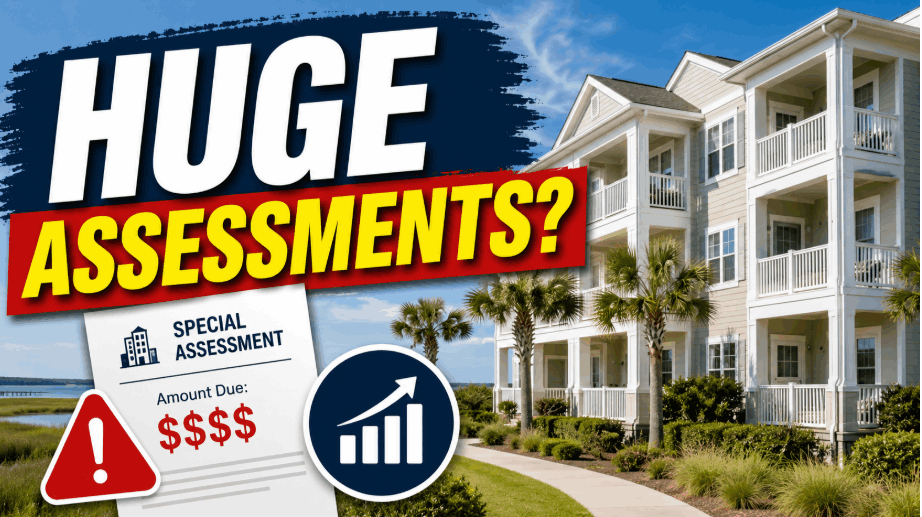
A special assessment is an extra charge billed to owners outside the normal monthly, quarterly, or annual regime fee.
On Hilton Head, this usually comes up with condos, villas, townhomes, and some attached-home regimes. A regular regime fee may cover routine items like exterior maintenance, landscaping, common-area upkeep, pest control, trash, pool care, management, master insurance, reserves, or other shared expenses depending on the property.
A special assessment is different. It is usually tied to a larger cost that the normal budget or reserves cannot fully cover. That could be an insurance spike, roof project, exterior repair, elevator work, balcony or stair repair, pool project, drainage issue, structural concern, hurricane-related repair, deferred maintenance, or another major building expense.
The key point is simple: the owner does not only own the inside of the unit. In a condo or villa regime, the owner also shares responsibility for the larger building and common property.
Fannie Mae explains this concept clearly in its condo project guidance: unlike a single-family house, a condo project’s condition affects all owners because they share financial obligations for buildings, exterior property, and amenities. Fannie Mae also notes that major repairs may be paid from HOA reserves or through a special assessment.
Why This Is Hitting Hilton Head Owners Harder Now
Hilton Head has a lot of older condo and villa inventory, especially in beach-oriented areas like Forest Beach, Folly Field, Sea Pines, Shipyard, Palmetto Dunes, and other resort-style locations. That older inventory is part of the island’s appeal, but it also means some buildings are reaching the point where routine maintenance is not enough.
A 1970s or 1980s building near the beach may have a great location, strong rental history, and loyal repeat owners. But the building still ages. Roofs age. Siding ages. Decks age. Railings age. Elevators age. Windows and doors age. Pools and common areas age. Salt air, humidity, storms, rental turnover, and heavy seasonal use can all add pressure.
The problem is not just that repairs are needed. The problem is that repairs cost more than many owners expect. Labor, materials, insurance, engineering, contractor availability, and code-related requirements can make major projects expensive fast.
This is why the cheapest-looking condo is not always the safest buy. A lower purchase price can be wiped out quickly if the building has underfunded reserves, rising insurance, major deferred maintenance, or an assessment already being discussed in meeting minutes.
Insurance Is a Big Part of the Assessment Problem
Insurance has become one of the biggest pressure points for coastal condo ownership.
A Hilton Head condo owner may think, “I have my own policy, so I’m covered.” But that is only part of the insurance picture. Condo ownership usually involves both the owner’s individual policy and the association’s master policy. The master policy is often one of the largest shared expenses inside a condo or villa regime.
Local reporting has already shown how painful this can get. In one Hilton Head example, an owner at Sea Side Villas was reported to be paying a $4,000 special assessment on top of the regular regime fee after the building’s master insurance policy rose from $115,223 to $690,577, a 499% change. The same reporting noted that condo insurance increases across Hilton Head, Bluffton, Okatie, Beaufort, and Fripp Island varied widely, with some communities seeing increases above 200%.
That does not mean every Hilton Head condo is facing that level of increase. It means buyers and owners cannot treat insurance as a small background item anymore.
The South Carolina Department of Insurance also highlights coastal insurance as its own consumer-resource category, with information on mitigation credits, SC Safe Home grants, catastrophe savings accounts, shopping for insurance, and storm preparedness. That alone tells you how important insurance has become in coastal ownership conversations.
For Hilton Head sellers, this matters because buyers are asking sharper questions. They want to know what the regime fee includes, what the master insurance covers, whether flood or wind coverage is included, what the deductibles are, whether premiums have jumped, and whether another assessment could be coming.
Reserves Are Where the Truth Usually Shows Up
A well-run regime does not just collect money for today’s bills. It also plans for future repairs.
That is where reserves matter.
Reserves are the funds set aside for larger future expenses. A building may look fine from the outside, but if the reserve account is weak and the property has major projects coming, owners may eventually face a large assessment.
This is one of the biggest mistakes buyers make when comparing Hilton Head condos. They look at the monthly regime fee and assume lower is better. Sometimes a lower fee is good. Sometimes it means the association has been underfunding the future.
A higher fee may be easier to understand if it includes strong insurance, exterior maintenance, reserves, building upkeep, amenities, and a realistic capital plan. A lower fee may be risky if the building has been keeping dues artificially low while delaying repairs.
That is why buyers should not only ask, “How much is the regime fee?” They should ask, “What does it cover, how healthy are the reserves, and what major projects are being discussed?”
Financing Rules Are Making This More Visible
The assessment issue is also tied to financing.
Fannie Mae’s condo project standards focus on project financial health, unresolved critical repairs, and sufficient master property insurance. Its Condo Status Finder page says condo project requirements are designed to protect buyers and homeowners from financial or safety risks tied to poor financial health, unresolved critical repairs, or insufficient master insurance coverage. It also lists common ineligible-project issues such as critical repairs, inadequate insurance, significant litigation, condotel characteristics, short-term rental issues, and similar concerns.
This matters because if a condo project raises concerns for lenders, buyers may have fewer financing options. That can affect the buyer pool, the time it takes to sell, and the negotiating leverage around a property.
Fannie Mae also has tools intended to help HOAs and managers understand potential project eligibility concerns, and the page notes that buyers with concerns can ask their HOA or lender to check whether potential eligibility issues have been identified.
For sellers, this is not just a technical lending issue. It is a marketing issue. A buyer may love the view, the beach access, or the renovation, but if the lender starts asking hard questions about insurance, reserves, deferred maintenance, or assessments, the deal can slow down or fall apart.
Older Buildings Are Not Bad — But They Need Better Due Diligence
Some of Hilton Head’s most desirable condo locations are in older buildings.
That is the tension.
An older oceanfront or near-ocean villa can still be a fantastic property for the right buyer. It may have beach access, rental demand, a strong location, walkability, views, or a layout that newer properties cannot duplicate. But older buildings require more serious review.
The right question is not, “Is this building old?” The better question is, “Has the building been maintained, funded, insured, and managed responsibly?”
A well-managed older building can be more attractive than a newer-looking property with weak financials. On the other hand, a beautifully renovated unit inside a poorly funded regime can still create major buyer concern.
That is where sellers have to be careful. Updating the kitchen and bathrooms helps, but it does not erase building-level objections. If buyers see high fees, recent assessments, unclear insurance, weak reserves, or major projects in the minutes, they may discount the property even if the interior looks great.
What Owners Should Watch Before an Assessment Hits
Most assessments do not appear out of nowhere. There are usually warning signs.
Owners should pay attention to board meeting minutes, annual budgets, reserve studies, insurance renewals, engineering reports, contractor bids, owner meeting discussions, and fee increase explanations. If the same building issue keeps showing up in meeting minutes, that may be the early signal that a larger cost is coming.
The most important documents are often not the glossy ones. The budget, reserve information, meeting minutes, insurance summary, and project discussions usually tell the real story.
Here are the questions I would want answered before buying or selling a Hilton Head condo with assessment risk:
- Are there any current, approved, pending, or discussed special assessments?
- What major projects are planned in the next one to five years?
- How much money is in reserves, and what are those reserves intended to cover?
- Has the master insurance premium increased recently?
- Are there any large deductibles owners need to understand?
- Are there unresolved building, balcony, stair, roof, elevator, drainage, or structural issues?
- Do recent meeting minutes mention deferred maintenance, capital projects, or owner concern about fees?
That is not legal, insurance, or lending advice. It is practical real estate due diligence. Buyers should review the documents with the right professionals before making assumptions.
How Assessments Affect Sellers
For sellers, assessment risk changes how a condo needs to be positioned.
If there is a current assessment, hiding from it is usually the wrong move. Buyers will find out during document review, lender review, or due diligence. When it feels like a surprise, it becomes a bigger problem.
A better strategy is to get clear early. Know the amount, payment schedule, purpose, due dates, whether it is fully approved, whether any portion has already been paid, and whether more projects are being discussed.
If the assessment is paying for a real improvement, that may be part of the explanation. A buyer may be more comfortable with an assessment for a clearly defined roof, exterior, elevator, or insurance issue than with vague uncertainty and weak documentation.
But pricing still matters. If two similar units are competing and one has a large unpaid assessment, buyers may expect a price adjustment, seller credit, or proof that the seller will pay the assessment at closing.
The seller’s job is not to pretend the assessment does not matter. The seller’s job is to make the cost understandable, price the property correctly, and avoid letting the issue surprise the buyer late in the process.
How Assessments Affect Buyers
For buyers, a special assessment is not always a deal killer. It depends on the reason, size, timing, and what the assessment solves.
An assessment for a major building improvement may actually make sense if the project is necessary and well-managed. A building that has already addressed expensive repairs may be more attractive than a building that is still delaying the same issues.
The bigger concern is uncertainty. Buyers get nervous when the documents are vague, the reserves are thin, insurance is unclear, or the board is discussing major work without a defined plan.
This is especially important for second-home buyers and rental-minded buyers. A property may look attractive based on purchase price and projected rental income, but the real cost of ownership includes regime fees, insurance, repairs, furnishings, management, permits where applicable, taxes, utilities, and possible assessments.
A strong rental location does not automatically protect you from building-level costs. A great beach area can still have a weak budget. A renovated unit can still sit inside an expensive capital project. A high gross rental number can still be less impressive once all ownership costs are included.
Why This Matters More in a Slower, More Selective Market
When buyers have more choices, they get pickier.
Recent Hilton Head-area reporting noted that 2025 brought rising inventory and longer marketing times across the area, giving buyers more choices and more time to make decisions. It also reported that Hilton Head condos and villas had 877 closed sales in 2025, down 3.9% from 2024, with median condo prices down 1.6% and average days on market up 51%.
That kind of market makes assessment issues more visible.
In a faster market, some buyers overlook problems because they feel pressure to move quickly. In a slower or more selective market, buyers compare more carefully. They look at regime fees, insurance, reserves, building condition, rental history, renovation level, and active competition.
For sellers, that means the listing needs to be honest and strategic. The property has to be priced against the full ownership picture, not just the best recent sale in the building.
For buyers, it means there may be more room to ask questions, compare documents, and make a better decision instead of chasing the prettiest unit with the lowest advertised price.
Bottom Line
Huge assessments usually happen when big building costs, insurance costs, deferred maintenance, or reserve shortfalls finally catch up with owners.
That does not make every assessment bad. It does mean buyers and sellers need to understand what is driving the number.
On Hilton Head, the condo itself is only part of the purchase. The building, regime, insurance, reserves, management, maintenance history, and future capital plan are part of the product too.
A beautiful villa in a great location can still be a risky buy if the regime health is weak. A property with a higher fee or recent assessment can still make sense if the association is well-managed and the money is solving real problems.
The goal is not to avoid every property with an assessment. The goal is to understand whether the assessment is a temporary cost, a sign of responsible maintenance, or a warning that bigger financial issues may still be ahead.
 FAQ
FAQ
Are special assessments common on Hilton Head condos?
They can happen, especially in older condo and villa regimes with major building, insurance, exterior, elevator, roof, pool, drainage, or capital-project needs. They are not automatically bad, but they should always be reviewed carefully.
Does a special assessment mean I should not buy the condo?
Not necessarily. The purpose matters. If the assessment is clearly defined, properly approved, and tied to a necessary improvement, it may be manageable. The bigger concern is when the assessment is vague, reserves are weak, or there are signs that more assessments may be coming.
Can a seller pay the assessment before closing?
Sometimes, depending on the contract, timing, association rules, and negotiation. Buyers and sellers should confirm the amount, due dates, payment status, and closing treatment with the association, attorney, and closing team.
What documents should buyers review?
Buyers should review the budget, reserves, insurance summary, master deed/bylaws, rules, meeting minutes, assessment notices, capital project updates, condo questionnaire, and any available engineering or inspection-related reports.
Do assessments affect financing?
They can. Lenders may review special assessments, reserves, insurance, deferred maintenance, litigation, delinquency rates, and overall project eligibility. Buyers financing a Hilton Head condo should speak with a lender familiar with local condo and villa properties early in the process.
Are high regime fees better than special assessments?
Not automatically. A high regime fee may reflect strong insurance, maintenance, reserves, and amenities. Or it may reflect expensive operating costs. A low regime fee may be efficient, or it may be underfunding the future. The important thing is what the fee covers and whether the budget is realistic.
Questions About Hilton Head Condo Fees or Assessments?
If you are buying or selling a Hilton Head condo, the assessment issue needs to be understood before it becomes a surprise.
I help buyers and sellers look beyond the listing photos and understand the full ownership picture: regime fees, insurance, reserves, building condition, rental relevance, financing concerns, and resale positioning.
You can reach me at joel@joelsells.com if you want help comparing Hilton Head condos or understanding how assessment risk could affect your next move.
Categories
- All Blogs (108)
- Hilton Head Condo Buyer Strategy (7)
- Beach Access & Coastal Ownership (1)
- Bluffton & Lowcountry Living (2)
- Bluffton Buyer / Seller / Comparison Topics (2)
- Bluffton Communities and Relocation (4)
- Bluffton Real Estate (8)
- Bluffton Real Estate / Relocation Guide (2)
- Buyer Advice (1)
- Buyer Guides (1)
- Costs, Fees, Insurance, Financing, and Due Diligence (1)
- Golf / Private Club / Gated Community Living (1)
- Golf / Private Club Communities (1)
- Hilton Head & Bluffton Buyer Strategy (1)
- Hilton Head Area Comparisons (1)
- Hilton Head Communities (4)
- Hilton Head Communities & Area Guides (11)
- Hilton Head Condo Buyer Guide (9)
- Hilton Head Condo Market Updates (1)
- Hilton Head Condo Seller Strategy (1)
- Hilton Head Condos & Villas (14)
- Hilton Head Homes (1)
- Hilton Head Homes + Island Living (2)
- Hilton Head Homes and Island Living (1)
- Hilton Head Real Estate (1)
- Hilton Head Seller Strategy (8)
- Hilton Head Short-Term Rental + Investment Guide (1)
- Hilton Head vs Bluffton (1)
- Hilton Head vs Bluffton / Relocation (3)
- Lowcountry Homeownership (1)
- Market Reports & Trends (4)
- Relocation and Retirement (1)
- Retirement & Relocation (1)
- Retirement and 55+ Communities (1)
- Retirement and Relocation (2)
- Retirement, 55+ & Private Club Living (3)
- Seller Strategy and Valuation (1)
- Short-Term Rentals & Investment (3)
Recent Posts