
The Real Cost of Owning a Hilton Head Vacation Condo

The Real Cost of Owning a Hilton Head Vacation Condo
A Hilton Head vacation condo can look simple online. You see the purchase price, the photos, the beach proximity, and maybe a rental estimate, and it feels like the decision should be pretty easy.
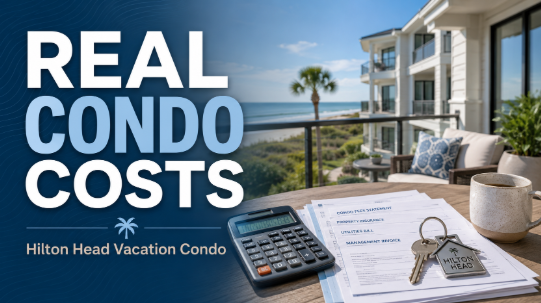
But the real cost of owning a Hilton Head vacation condo is not just the mortgage payment. It is the full carrying cost after you include regime fees, insurance, taxes, repairs, furnishings, management, rental rules, permits, reserves, and the possibility of future assessments. That does not mean buying a vacation condo is a bad idea. It just means the cheapest condo on paper is not always the cheapest condo to own.
This is where a lot of buyers get surprised. They compare purchase prices, but they do not always compare the real monthly and annual cost of ownership. On Hilton Head, that can completely change how two condos stack up against each other.
Purchase Price Is Only the Starting Point
The purchase price gets the most attention because it is the easiest number to compare. A $425,000 condo feels cheaper than a $525,000 condo. That part is obvious. What is not always obvious is whether the lower-priced condo has higher monthly fees, more repair exposure, weaker rental flexibility, older furnishings, more building uncertainty, or insurance questions that make the total cost higher over time.
That is why I do not like looking at Hilton Head vacation condos only by list price. The better question is what the property costs to own after closing. A buyer using the condo mostly for family vacations may judge that differently than a buyer trying to offset costs with rentals. Either way, the math needs to include more than the purchase price.
Regime Fees Can Be Useful, But Buyers Need to Understand Them
Regime fees are one of the biggest cost categories buyers notice with Hilton Head condos and villas. Some buyers immediately see a high monthly fee and assume it is bad. That is not always fair. A fee may cover important items such as exterior maintenance, landscaping, common areas, amenities, building insurance, management, trash, pest control, cable, internet, water, sewer, or reserve funding. The problem is that every community is different.
The useful question is not only, "How much is the fee?" The better question is, "What does the fee include, what does it not include, and is the association financially prepared for the building it owns?"
A higher fee can sometimes make sense if it covers meaningful costs and the association is well run. A lower fee can look attractive until you realize the owner is paying more separately, the reserves are weak, or major projects may be coming. That is why buyers should compare the fee against the actual services, insurance structure, reserves, past assessments, and future maintenance needs.
Insurance Matters More on Coastal Property
Insurance is another area where Hilton Head condo buyers need to slow down. Coastal ownership is different from owning a typical inland property. A buyer may need to understand the association's master insurance policy, the owner's unit policy, contents coverage, loss assessment coverage, flood exposure, wind and hail considerations, and whether rental use changes the insurance conversation.
The mistake is assuming that the regime fee automatically solves the insurance issue. Sometimes the association's policy covers major building items, but the owner still needs separate coverage. Sometimes flood insurance, wind coverage, or interior coverage needs to be reviewed more carefully. Sometimes the lender will have its own requirements before approving financing.
This is not something to guess on. Before a buyer gets serious about a Hilton Head vacation condo, insurance needs to be reviewed for the specific unit, building, association, and intended use.
Property Taxes Can Change the Math
Taxes are another piece buyers need to understand early. In Beaufort County, an owner-occupied primary residence is generally assessed at 4%, while a secondary residence is assessed at 6%. The county explains that the assessment ratio is applied to the property's value to determine assessed value, and millage is then used to calculate the tax.
That matters because many Hilton Head vacation condo buyers are not buying their primary residence. They may be buying a second home, vacation property, or rental property. The tax treatment can be different from what they are used to in their home state, and it should be estimated before they assume the payment works.
This is especially important for out-of-state buyers who are comparing Hilton Head to other resort markets. A condo that looks manageable from the purchase price alone may feel very different once taxes, insurance, fees, and carrying costs are added together.
Rental Use Adds Another Layer
A lot of Hilton Head vacation condo buyers want the option to rent the property when they are not using it. That can make sense, but rental income should never be treated as free money. Gross rental income is not net income.
If the property is used as a short-term rental within the Town of Hilton Head Island, the Town requires a short-term rental permit for each property being offered as a short-term rental. The Town also states that the STR permit is separate from the annual business license, is valid from May 1 through April 30, and is non-transferable. The Town's current permit-fee structure shows an annual fee of $150 per bedroom, along with the requirement to maintain an active Town business license and comply with South Carolina accommodations tax laws.
Rental tax compliance also matters. The Town says people or businesses renting sleeping accommodations for less than 90 days must open an account with the Town's Revenue Services Office, and the Town's accommodations tax and beach preservation fee equals 3% of the gross rental sales price. South Carolina also has accommodations tax rules, and the Department of Revenue says owners who directly book short-term rentals may need a retail license, depending on how the rental is booked and managed.
That is only the government side. Buyers still need to verify the condo association's rental rules, minimum stay rules, guest rules, pet rules, parking rules, owner-use restrictions, management requirements, and whether the specific property actually fits the rental plan.
Management Costs Can Eat Into Rental Income
If a buyer is planning to rent the condo, management is another major cost. Some owners self-manage. Others use a local vacation-rental company. Others use a hybrid approach. The right answer depends on how hands-on the owner wants to be, how far away they live, how often they plan to use the condo, and how much service they expect.
Management can affect income, guest experience, cleaning coordination, pricing, maintenance, reviews, communication, and owner stress. It can also affect how much of the gross rental number actually makes it to the owner.
This is why rental projections should be reviewed carefully. A strong gross number does not automatically mean a strong net number. The buyer still has to subtract management, cleaning coordination, supplies, repairs, utilities, taxes, insurance, fees, platform costs, furnishings, and reserves for future replacement.
Repairs and Furnishings Are Real Ownership Costs
Vacation condos get used differently than primary residences. Guests are harder on furniture, appliances, flooring, doors, mattresses, linens, kitchenware, and HVAC systems. Even if a condo looks good today, the owner still needs to plan for ongoing replacement.
That matters because a furnished condo is not always a finished condo. The furniture may photograph well but be near the end of its useful life. The appliances may work today but be older. The HVAC may pass inspection but still need replacement sooner than the buyer expects. The flooring may look acceptable now but struggle under rental use.
For a buyer planning personal use only, these costs still matter. For a buyer planning rental use, they matter even more because condition affects guest satisfaction, reviews, repeat bookings, and future resale appeal.
Reserves and Assessments Can Change the Long-Term Cost
One of the biggest differences between a normal condo purchase and a strong condo purchase is association health. Buyers should care about reserves, budgets, insurance, meeting minutes, maintenance history, upcoming projects, and special assessments.
A special assessment is not automatically a deal killer. Sometimes an assessment funds necessary work that protects the building long term. The problem is uncertainty. Buyers need to know what the assessment is for, how much it costs, who pays it, when it is due, whether more work is expected, and whether lenders have any concerns.
This is where two condos in the same general area can be very different purchases. One building may have a clearer maintenance plan, stronger reserves, and fewer unknowns. Another may have a lower purchase price but more uncertainty behind the scenes.
The Cheapest Condo Is Not Always the Better Buy
A lower price can be attractive, but it does not automatically mean the buyer is getting a better deal. If the condo needs renovation, has higher carrying costs, limited rental flexibility, weaker building confidence, difficult financing, poor parking, older systems, or furniture that needs replacement, the lower price may not mean much.
The better comparison is total ownership cost. What will this condo actually cost to own over the next three to five years? How much will it cost if rental income is lower than expected? How much will it cost if the owner uses it during peak rental weeks? How much flexibility does the buyer have if fees rise, insurance changes, or repairs come up?
That is the real decision. Not just whether the condo is affordable to buy, but whether it is comfortable to own.
How I Would Think About It as a Buyer
If I were comparing Hilton Head vacation condos, I would not start by asking which one has the lowest price. I would start by asking how I planned to use it.
If the goal is family use, then convenience, condition, parking, beach access, storage, comfort, and long-term carrying cost may matter more than maximum rental income. If the goal is rental income, then the numbers need to be reviewed more seriously, including rules, permits, management costs, guest appeal, seasonality, owner use, and net income. If the goal is a mix of both, the buyer needs to be honest about which one matters more when the two goals conflict.
That is where Hilton Head condo buying becomes more detailed than people expect. The right condo is not just the one with the best photos or the lowest price. It is the one where the location, condition, fees, insurance, rental rules, building health, and total cost all make sense together.
Final Thought
Owning a Hilton Head vacation condo can be a great experience, but buyers need to understand the full cost before they fall in love with the photos. The list price is only the beginning. The real number is what the condo costs to own, use, maintain, insure, manage, and eventually resell.
That does not mean buyers should be scared. It means they should be prepared. A good Hilton Head condo purchase should work on paper and in real life.
Message me if you are comparing Hilton Head condos and want help looking beyond the list price.
 FAQ
FAQ
What is the real cost of owning a Hilton Head vacation condo?
The real cost includes the purchase price, financing, regime or HOA fees, property taxes, insurance, utilities, repairs, furnishings, management, permits if rented, reserves, and potential special assessments. The exact number depends on the specific condo, building, association, and how the owner plans to use the property.
Are Hilton Head condo fees always a bad thing?
No. A higher fee is not automatically bad if it covers meaningful services, maintenance, insurance, amenities, and reserve funding. The important question is what the fee includes, what it excludes, and whether the association is financially prepared for future building needs.
Do I need a permit to short-term rent a Hilton Head condo?
If the property is within the Town of Hilton Head Island and is offered as a short-term rental, the Town requires a short-term rental permit for each property. The permit is separate from the annual business license and is valid for the specific property only.
Are taxes different for a vacation condo than a primary residence?
They can be. Beaufort County lists owner-occupied primary residences at a 4% assessment ratio and secondary residences at a 6% assessment ratio. Buyers should estimate taxes for their specific use before assuming the payment works.
Can rental income cover the cost of owning a Hilton Head condo?
Sometimes rental income can help offset ownership costs, but buyers should not rely on gross income alone. The better number is net income after management, fees, taxes, insurance, utilities, repairs, cleaning, furnishings, supplies, owner use, and reserves.
Categories
- All Blogs (108)
- Hilton Head Condo Buyer Strategy (7)
- Beach Access & Coastal Ownership (1)
- Bluffton & Lowcountry Living (2)
- Bluffton Buyer / Seller / Comparison Topics (2)
- Bluffton Communities and Relocation (4)
- Bluffton Real Estate (8)
- Bluffton Real Estate / Relocation Guide (2)
- Buyer Advice (1)
- Buyer Guides (1)
- Costs, Fees, Insurance, Financing, and Due Diligence (1)
- Golf / Private Club / Gated Community Living (1)
- Golf / Private Club Communities (1)
- Hilton Head & Bluffton Buyer Strategy (1)
- Hilton Head Area Comparisons (1)
- Hilton Head Communities (4)
- Hilton Head Communities & Area Guides (11)
- Hilton Head Condo Buyer Guide (9)
- Hilton Head Condo Market Updates (1)
- Hilton Head Condo Seller Strategy (1)
- Hilton Head Condos & Villas (14)
- Hilton Head Homes (1)
- Hilton Head Homes + Island Living (2)
- Hilton Head Homes and Island Living (1)
- Hilton Head Real Estate (1)
- Hilton Head Seller Strategy (8)
- Hilton Head Short-Term Rental + Investment Guide (1)
- Hilton Head vs Bluffton (1)
- Hilton Head vs Bluffton / Relocation (3)
- Lowcountry Homeownership (1)
- Market Reports & Trends (4)
- Relocation and Retirement (1)
- Retirement & Relocation (1)
- Retirement and 55+ Communities (1)
- Retirement and Relocation (2)
- Retirement, 55+ & Private Club Living (3)
- Seller Strategy and Valuation (1)
- Short-Term Rentals & Investment (3)
Recent Posts

Should You Buy in Beaufort Instead of Hilton Head or Bluffton?

Hampton Hall vs Hampton Lake: Golf-Centered or Lake-Centered Living?

Multigenerational Living in Bluffton: The Floor Plan Matters More Than the Bedroom Count

Buying a Lowcountry Home With a Private Dock: What Buyers Need to Verify

Selling After You Move Out: Vacant, Staged, or Left Furnished?

Flood Zone, Elevation, and Insurance: Why the House Next Door Can Carry a Different Risk

Septic vs Sewer in Bluffton and the Lowcountry: What Changes for the Buyer?

Buying a Stucco Home in the Lowcountry: What Buyers Should Investigate
Private Pool vs Community Pool: What Bluffton Buyers Are Really Choosing

Buying a Golf-Course Home When You Do Not Actually Golf