Buying a Lowcountry Home With a Private Dock: What Buyers Need to Verify
Buying a Lowcountry Home With a Private Dock: What Buyers Need to Verify
A private dock can sell the house before the buyer knows whether the dock actually works.
The view is easy to appreciate. So is the idea of walking out the back door, lowering a boat into the water and leaving whenever you want. But one showing at high tide does not tell you whether the dock has enough water at low tide, whether the structure matches its permits, whether the boat lift can handle your boat or whether the insurance and maintenance costs make sense.
A dock should not be treated like a patio, pool or ordinary backyard improvement. It is a separate coastal structure affected by tides, property lines, environmental rules, government permits, community restrictions and constant exposure to salt, sun, wind and storms.
The dock may be the reason you want the property. It should also receive its own due-diligence review before you pay a waterfront premium.
Decide What You Expect the Dock to Do
Buyers often use the phrase “private dock” as though it describes one specific benefit. It does not.
One buyer may need dependable access for a center-console boat. Another may want a place to launch kayaks and paddleboards. A third may care more about fishing, crabbing or having a quiet place to sit near the water.
Those are different requirements.
A sunset platform and a working boat dock may be the same structure, but they are not the same purchase.
Before judging the dock, match it against the boat and the way the property will be used. Boat length, beam, draft and lift capacity all matter. So do the route from the dock to open water, bridge clearances, narrow turns, current, wake exposure and whether the boat can safely leave and return during the hours the owner is likely to use it.
A listing may describe “water access” without promising unrestricted boating access. The buyer has to determine what that access actually supports.
See the Property Near Low Tide
High tide can make almost every waterfront property look more capable than it really is.
A dock that appears to sit in several feet of water during a showing may be surrounded by exposed mud a few hours later. The floating dock may settle onto the creek bottom. The route from the property may contain a shallow section that limits when the boat can leave or return.
That does not automatically make the dock undesirable. A shallow tidal creek can still work well for kayaks, paddleboards, skiffs and buyers who do not mind planning around the tide. It becomes a problem when the buyer pays for dependable boat access and receives a narrow operating window instead.
Visit the property at or near predicted low tide. Look at the water beneath the dock, the channel leading away from it and any shallow turns between the property and the larger waterway. NOAA provides official tide and water-level information, but the useful answer still comes from matching the local conditions with the buyer’s specific boat and route.
Do not rely only on the seller’s description of the depth. Ask how it was measured, where it was measured and at what stage of the tide. A depth reading beside the pierhead does not solve a shallow section farther down the creek.
When boating access is a major reason for buying, a low-tide visit with an experienced local boater, marine contractor or other qualified professional can be more useful than another ordinary house showing.
Confirm That the Dock Matches Its Permits
In coastal South Carolina, alterations within coastal waters and tidelands may require authorization from the South Carolina Department of Environmental Services Bureau of Coastal Management. Private dock construction, alterations, additions and certain repair work fall within that regulatory system. Federal authorization may also be involved through the U.S. Army Corps of Engineers, and Beaufort County maintains its own dock-application process for properties under county jurisdiction.
The buyer should request the complete dock file, not merely accept a statement that the structure was permitted.
Useful records may include the original permit, approved drawings, permit number, amendments, maintenance approvals, construction correspondence and any documents related to the boat lift, roof, utilities, mooring piles or later additions.
Then compare the paperwork with the structure standing at the property.
A dock may have started as a permitted structure and later received a larger pierhead, additional pilings, a roof, utilities or a different lift. Those additions may have required separate authorization. The existence of an original permit does not prove that every current component was approved.
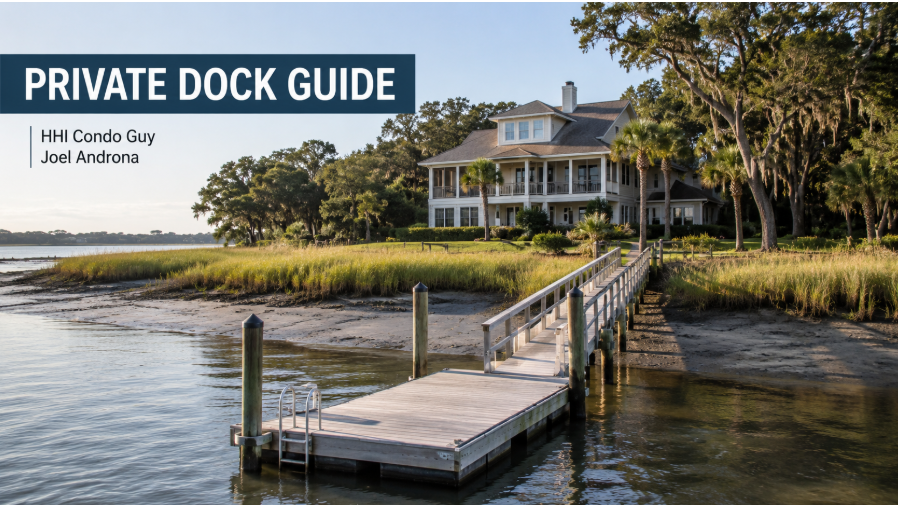
The dock in the photographs is not enough. The permit file, survey, title documents and physical structure should all describe the same improvement.
Understand What the Permit Does—and Does Not—Transfer
An active coastal permit may be transferred through the SCDES process, which requires involvement from both the existing permit holder and the new property owner. An expired permit cannot simply be treated the same way as an active permit. The buyer’s closing attorney and the appropriate permitting office should confirm whether a transfer, amendment, maintenance authorization or other action applies to the specific dock.
This matters most when work is incomplete, a repair or expansion is underway or the seller has an active authorization that has not been fully closed out.
The sale of the house should not leave the buyer with a permit deadline, unfinished work or responsibility for conditions the buyer never reviewed.
Review the Survey, Easements and Dock Corridor
A dock extends beyond the ordinary upland portion of the property, which makes the survey and title review especially important.
The buyer should know where the property lines extend toward the water, whether the dock remains within its approved corridor and whether any part of the structure crosses or approaches a neighboring corridor. Shared access easements, licenses and recorded agreements should be identified before closing.
This becomes even more important when the dock is shared by two properties, reached across association property or governed by a development-wide dock plan.
SCDES uses Dock Master Plans in some developments to manage dock locations, corridors, access conflicts and environmental effects. Its guidance states that affected sales contracts should reference the approved plan.
The closing attorney should also confirm exactly what conveys with the property. Boat lifts, floating platforms, dock boxes and other equipment can become points of disagreement when the contract is vague.
A buyer should not reach closing and discover that an expensive lift was excluded, owned by a neighbor or scheduled for removal.
Shared Docks Need More Than a Handshake
A shared dock can reduce construction and maintenance costs, but only when the rights and responsibilities are clear.
The agreement should explain who may use the dock, which side each owner controls, how utilities are divided, who schedules repairs, how storm preparation is handled and what happens when one owner wants to replace the lift or rebuild part of the structure.
SCDES encourages joint-use docks in appropriate situations and specifically recommends that owners define maintenance responsibilities and use rights in advance.
An informal arrangement may work while two friendly neighbors own the properties. The risk appears when one property is sold, one owner stops contributing or the structure needs a major repair.
The agreement has to work for the next owner, not just the current neighbors.
Order a Separate Dock and Boat-Lift Inspection
A general home inspection may identify obvious dock concerns, but a waterfront buyer should not assume the inspector has the marine experience needed to evaluate pilings, structural framing, lift equipment and marine electrical systems.
A marine contractor, structural engineer or other qualified dock professional should examine the structure based on its age, design and exposure.
The inspection should address the pilings, caps, stringers, decking, fasteners, handrails, gangway, floating dock, flotation system and connections. Any boat lift should be evaluated for capacity, cable condition, motors, switches, bunks, pulleys and visible corrosion. Electrical service near the water deserves its own careful review.
A dock can be standing and still be expensive.
The buyer needs to know whether the structure is sound for ordinary use, whether repairs are approaching and whether the current lift is suitable for the boat the buyer plans to own.
Separate Ordinary Maintenance From Major Reconstruction
Coastal structures require continuing maintenance. Sun exposure, salt, tidal movement, marine growth, corrosion, storms and repeated boat use do not stop after closing.
SCDES may allow normal maintenance and repair without a new permit when the dock was previously permitted or grandfathered, remains generally intact and functional, and the work stays within the original dimensions. Expansion, additions or major rebuilding can require additional authorization or written approval.
That distinction can materially change the buyer’s future cost.
Replacing a few boards is different from replacing failing pilings, rebuilding the pierhead or changing the lift configuration. Before closing, obtain a realistic repair estimate and ask whether the proposed work can be completed as maintenance or requires a new regulatory review.
Do not assume that an old dock can automatically be rebuilt in any size or configuration the buyer prefers.
Ask the Insurance Questions Directly
The home being insurable does not mean every part of the dock is protected under every cause of loss.
The buyer should ask the insurance agent specifically how the fixed walkway, floating dock, boat lift, electrical equipment and liability exposure are treated. Wind, named storms, flooding, collision and deterioration may be handled differently depending on the policy and carrier.
FEMA’s National Flood Insurance Program explains that standard flood coverage focuses on the insured building and contents and excludes many items outside the building, including walks, decks, patios, fences and seawalls. That should be enough to stop a buyer from assuming the dock is automatically protected simply because the home has flood insurance.
Ask for the answer in writing when the dock carries meaningful replacement value.
The buyer should also discuss liability for guests, contractors and unauthorized users, especially when the dock is visible from a public waterway or shared with another owner.
Check the Community Rules Before Planning Improvements
Government approval is only one layer.
A POA, HOA or architectural review board may regulate dock construction, roof design, boat lifts, lighting, utilities, boat size, storage, repair methods and contractor access. A community may also have an approved Dock Master Plan that limits where an individual owner can build or what can be added later.
State regulations currently use creek width and site conditions when determining allowable dock size, and some narrow creeks may not support a dock at all. Waterfront frontage does not guarantee permission for a new private dock or a larger replacement structure.
This becomes important when the buyer likes the existing dock but plans to add a covered lift, larger pierhead, jet-ski platform or different boat-storage system.
Do not price the property based on an improvement that has not been approved.
Pay for the Dock’s Actual Utility, Not the Photograph
A permitted dock with dependable low-tide access, a sound structure and a lift suited to the buyer’s boat may justify a meaningful premium.
A shallow tidal dock may still be valuable for fishing, kayaking and the setting it creates. But that is a different value than dependable access for a larger powerboat.
The purchase should reflect the dock’s actual utility:
How often can it be used?
What type of boat can it support?
What repairs are approaching?
What rights transfer with the property?
What restrictions control future changes?
A prettier house with weak boating access may be the wrong purchase for a serious boater. A less updated house with a functional, permitted dock may be harder to replace.
The dock should earn its premium through verified use, not through the emotional effect of one waterfront showing.
A Better Lowcountry Dock Review
Before the due-diligence period ends, the buyer should have a clear answer on the low-tide depth, route to open water, permitted configuration, survey and title rights, community restrictions, structural condition, lift capacity, repair outlook and insurance treatment.
That review should involve the appropriate professionals rather than depending on one person to answer every question. The agent can coordinate the process, but permitting offices, the closing attorney, surveyor, insurance agent and marine contractor each have a different role.
Buyers comparing waterfront HILTON HEAD ISLAND HOMES and BLUFFTON HOMES should make the dock review part of the property comparison from the beginning. Waiting until after closing removes most of the buyer’s leverage.
The Bottom Line
Buying a Lowcountry home with a private dock can create an ownership experience that is difficult to duplicate. It can also create expensive disappointment when the buyer assumes that waterfront means deep water, that an existing structure must be legal or that every dock works for every boat.
Verify the dock with the same seriousness you would use for the house.
See it at low tide. Read the permit file. Review the survey and title documents. Inspect the structure. Confirm the insurance. Understand the community rules.
The best waterfront purchase is not merely the property with the nicest dock in the photographs. It is the property where the home, dock, water access and long-term cost all work together.
Reach out through my PERSONALIZED HOME SEARCH if you are comparing Lowcountry waterfront homes and want help sorting through the actual properties—not just the listing descriptions.
 FAQ SECTION
Frequently Asked Questions About Buying a Lowcountry Home With a Private Dock
Does waterfront property automatically qualify for a private dock?
No. Dock approval can depend on creek width, property configuration, environmental conditions, an approved Dock Master Plan, community restrictions and state, federal or local permitting requirements. Some waterfront properties may not qualify for a new individual dock.
Does a private dock mean the property has deep-water access?
No. A private dock may serve deep water, a shallow tidal creek or primarily kayak and paddleboard access. Buyers should verify the depth at low tide and the full route from the dock to the larger waterway.
Should buyers visit a dock at low tide?
Yes, especially when boating access affects the purchase decision. A low-tide visit can reveal exposed mud, shallow channels and limits that may not be visible during a high-tide showing.
Who regulates private docks in coastal South Carolina?
Depending on the property and work involved, the review may include SCDES Bureau of Coastal Management, the U.S. Army Corps of Engineers and the applicable county or municipality. Community associations may impose additional requirements.
Does a dock permit automatically transfer when the home sells?
An active SCDES permit may be transferred through the agency’s process, but the correct procedure depends on the status of the permit and structure. The buyer should have the closing attorney and permitting office confirm what applies.
Is a standard home inspection enough for a private dock?
Not necessarily. Buyers should ask whether the home inspector evaluates marine structures and boat lifts. A separate inspection by a qualified marine contractor or engineer may be appropriate.
Categories
- All Blogs (108)
- Hilton Head Condo Buyer Strategy (7)
- Beach Access & Coastal Ownership (1)
- Bluffton & Lowcountry Living (2)
- Bluffton Buyer / Seller / Comparison Topics (2)
- Bluffton Communities and Relocation (4)
- Bluffton Real Estate (8)
- Bluffton Real Estate / Relocation Guide (2)
- Buyer Advice (1)
- Buyer Guides (1)
- Costs, Fees, Insurance, Financing, and Due Diligence (1)
- Golf / Private Club / Gated Community Living (1)
- Golf / Private Club Communities (1)
- Hilton Head & Bluffton Buyer Strategy (1)
- Hilton Head Area Comparisons (1)
- Hilton Head Communities (4)
- Hilton Head Communities & Area Guides (11)
- Hilton Head Condo Buyer Guide (9)
- Hilton Head Condo Market Updates (1)
- Hilton Head Condo Seller Strategy (1)
- Hilton Head Condos & Villas (14)
- Hilton Head Homes (1)
- Hilton Head Homes + Island Living (2)
- Hilton Head Homes and Island Living (1)
- Hilton Head Real Estate (1)
- Hilton Head Seller Strategy (8)
- Hilton Head Short-Term Rental + Investment Guide (1)
- Hilton Head vs Bluffton (1)
- Hilton Head vs Bluffton / Relocation (3)
- Lowcountry Homeownership (1)
- Market Reports & Trends (4)
- Relocation and Retirement (1)
- Retirement & Relocation (1)
- Retirement and 55+ Communities (1)
- Retirement and Relocation (2)
- Retirement, 55+ & Private Club Living (3)
- Seller Strategy and Valuation (1)
- Short-Term Rentals & Investment (3)
Recent Posts