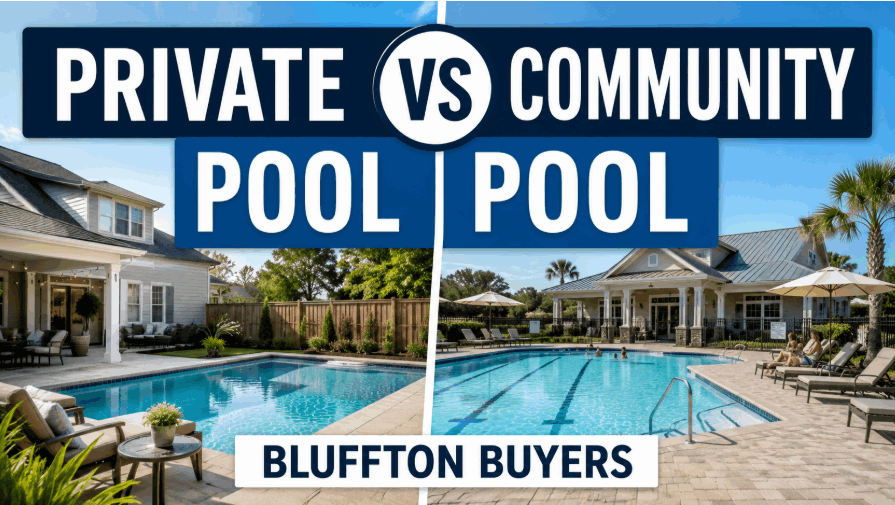
Private Pool vs Community Pool: What Bluffton Buyers Are Really Choosing
Private Pool vs Community Pool: What Bluffton Buyers Are Really Choosing
A lot of Bluffton buyers put "pool" on the search list before they have decided what kind of pool ownership they actually want.
A private pool and a community pool may satisfy the same search filter, but they create very different versions of daily life. One gives you privacy, control and immediate access. The other gives you a place to swim without turning the pool into another system attached to your house.
That distinction can change the home, neighborhood, yard, price range and maintenance responsibility a buyer should be considering.
The mistake is treating this as a simple amenity comparison.
Buyers comparing BLUFFTON HOMES are usually making a much larger choice between personal outdoor space and shared neighborhood amenities. The pool is only the most visible part of that decision.
A Private Pool Gives You Control—and the Entire Job
The strongest argument for a private pool is not that it looks good in the listing photos. It is that the pool becomes part of the home.
You can swim early in the morning, sit outside late at night, invite friends over, use it without packing a bag and control who is in the space. Parents can watch children from the patio. Guests can move between the house and pool without leaving the property. Owners who entertain regularly may use the entire backyard differently because the pool is always available.
A private pool gives you control. It also gives you the entire job.
The pump, filter, heater, lighting, surface, deck, drainage, fencing and water chemistry all belong to the homeowner. Even when a pool service handles the weekly work, the owner still carries the repair risk when equipment fails or the pool needs resurfacing.
That does not make a private pool a bad purchase. It means the buyer should want the ownership responsibility as much as the swimming.
Insurance belongs in that calculation as well. The South Carolina Department of Insurance identifies pools as an added liability risk and recommends that homeowners review their liability protection and safety requirements with their insurance professional.
A buyer should price the insurance before closing rather than assuming the pool will have little effect on the policy.
A Community Pool Removes Work but Adds Friction
A community pool gives buyers access to swimming without placing the physical pool, equipment and weekly maintenance in their backyard.
That can preserve more usable yard space, reduce the number of systems attached to the home and make it easier to leave town without worrying about what happened to the water while the owner was gone. Buyers who travel frequently, own multiple properties or simply do not want another maintenance responsibility may find that arrangement much easier.
The tradeoff is convenience.
Using the pool may require walking, driving, carrying towels and following posted hours. The owner does not control the temperature, crowd level, guest policy, programming or maintenance schedule. A community pool can be nearby and still feel inconvenient enough that the buyer rarely uses it.
Sun City Hilton Head, for example, currently publishes different operating hours for its outdoor and indoor pools, exclusive-use periods for certain programs and rotating children's pool hours. That does not make the pools less useful. It shows why "the community has a pool" is not enough information to make the decision.
A community pool removes the maintenance, but it also removes the spontaneity.
For some buyers, that is an easy trade. For others, walking or driving to the pool changes the experience enough that the amenity becomes something they planned to use rather than something they actually use.
Buyers Are Choosing How They Want to Use the Home
The most useful question is not whether a private pool is better than a community pool. It is how the buyer expects an ordinary week in the home to work.
A household that swims several times a week, entertains regularly and wants the backyard to function as another living area may get substantial use from a private pool.
A buyer who expects to swim occasionally, travels frequently or would rather keep the yard available for pets, gardening or open space may be happier using the community pool.
Do not pay for a private pool based on the version of your life you imagine. Pay for it based on how often you will actually walk outside and use it.
The same rule applies to community amenities. Buyers sometimes choose a neighborhood because the pool, clubhouse and recreation areas look impressive during the tour. Six months later, they may realize that the home's layout, location and daily convenience matter much more than the amenity package.
That is especially important when comparing 55+ COMMUNITIES. One buyer may see the pool as part of a larger social and fitness routine. Another may prefer a quieter home with more personal outdoor space and little interest in scheduled activities.
The better purchase is the one that matches the buyer's actual routine rather than the strongest marketing photo.
The Backyard May Matter More Than the Water
A private pool changes the usable lot.
On a larger homesite, the pool may still leave room for lawn, landscaping, pets, outdoor dining and privacy. On a smaller homesite, the same pool may consume most of the backyard and place the deck close to neighboring properties.
That is why two Bluffton homes with private pools can feel completely different. The pool itself may be attractive, but the lot decides whether the outdoor space feels open, private and useful.
Buyers should also think about shade, nearby trees, drainage and the distance between the pool and the main living areas. A pool surrounded by mature Lowcountry trees may look appealing while also requiring more cleaning. A pool separated from the house by an awkward layout may receive less use than one connected naturally to a screened porch, patio or main living area.
The pool should support the home—not compensate for the wrong home.
Buying a Home With Room for a Future Pool Is a Separate Decision
Some buyers try to split the difference by purchasing a home without a private pool and planning to add one later.
That can work, but "the yard looks large enough" is not verification.
Inside the Town of Bluffton's jurisdiction, the current building-permit checklist treats residential swimming pools, spas and water features as permitted projects and calls for a scaled site plan or survey. The specific property may also be affected by setbacks, easements, drainage requirements, utility locations and separate HOA architectural approval.
Before paying more for a supposedly pool-ready lot, buyers should confirm that a pool can actually be approved and placed where they want it.
A large yard can lose usable space quickly once setbacks, easements, equipment placement, fencing and drainage are considered. The right time to discover that is before closing, not after the homeowner has already designed the backyard around a pool that cannot be built as planned.
The Cost Comparison Is Not Private Pool Versus HOA Dues
Buyers sometimes compare the expected cost of maintaining a private pool with the neighborhood's HOA or POA fee. That comparison is usually incomplete.
Community dues may also support roads, landscaping, security, common areas, management, recreation facilities and other neighborhood services. A buyer is not necessarily paying the entire fee for access to the pool.
The better comparison is the total ownership cost of each home.
For the private-pool home, that includes the purchase-price difference, insurance, utilities, regular service and a reserve for equipment or surface work.
For the community-pool home, it includes the dues, what those dues cover, the financial condition of the association and whether the buyer will use enough of the amenity package to justify the cost.
A lower-maintenance pool arrangement does not automatically mean a lower-cost home. It simply shifts the responsibility from one homeowner to the broader association.
A Private Pool Does Not Create an Automatic Resale Premium
Pools can attract buyers, especially in warmer markets, but the resale effect should not be reduced to a national percentage.
Realtor.com's 2025 listing analysis found that homes advertised with pools carried higher asking prices nationally. The same research also found that pool homes were typically larger and may have been concentrated in more expensive locations, meaning the difference cannot be treated as the value of the pool alone. Realtor.com also cautioned sellers against overpricing solely because a pool is present.
Bluffton buyers still evaluate the entire property.
A private pool can strengthen a home when the pool is attractive, well maintained, properly connected to the outdoor living area and appropriate for the price point. It can weaken the response when the equipment is old, the surface needs work, the yard has disappeared or the seller expects buyers to ignore other shortcomings because the home has a pool.
A community pool can preserve a broader resale audience because buyers who do not want private-pool responsibility are not forced to accept it. However, the community amenity only helps when it is maintained, financially supported and practical for residents to use.
Buyers do not resell the summer memory. They resell the condition, design, cost and buyer appeal of the entire property.
Inspect the Pool as Its Own Part of the Property
When a home already has a private pool, buyers should treat it as a separate mechanical and structural system rather than a decorative backyard feature.
The evaluation should address the visible condition of the surface and deck along with the pump, filter, heater, automation, lighting, water features, fencing and drainage. Buyers should also ask about equipment age, repair history, ongoing service and any available permit documentation.
A pool that appears clean during a showing can still carry near-term expenses. Conversely, older equipment is not automatically a reason to reject the home if the price reflects the condition and the buyer has a clear replacement plan.
The goal is not to avoid every future repair. The goal is to understand what ownership is likely to require.
 Five Questions That Usually Settle the Decision
How often will you realistically swim?
Occasional swimmers may be satisfied with a community pool. Buyers who expect the pool to become part of the daily routine may value private access much more.
Do you want the pool or the backyard experience?
Some buyers mainly want a place to exercise. Others want privacy, outdoor entertaining and the ability to move between the house and pool throughout the day. Those are different purchases.
How much maintenance responsibility do you want?
A private pool gives the owner control over cleanliness, temperature and access. It also means the owner carries the operating and repair responsibility.
What are you giving up to get it?
A strict private-pool requirement may reduce the number of available homes, push the buyer into a different price range or eliminate houses with better layouts, locations or lots.
Would you still choose the home without the pool?
That question protects buyers from allowing one feature to excuse the wrong floor plan, poor condition, weak location or uncomfortable ownership cost.
The Better Choice Depends on What You Want the House to Do
A private pool usually works best for buyers who value privacy, immediate access, entertaining and control enough to accept the maintenance, liability and repair responsibility.
A community pool usually works better for buyers who want occasional access, fewer personal maintenance obligations and a neighborhood amenity package without giving most of the backyard to the pool.
Neither option is automatically better.
The useful decision is whether the pool arrangement improves the way the buyer will actually live in the home.
You can SEARCH CURRENT LISTINGS to compare Bluffton homes with private pools, community pools and no pool requirement at all. Message me if you want help sorting through the actual properties instead of relying on the pool filter alone.
Frequently Asked Questions
Is a private pool worth it in Bluffton?
It can be worth it for a buyer who expects to swim frequently, entertain outside and use the pool as part of the home. It may be harder to justify for someone who travels often, dislikes maintenance or would rather preserve the yard.
Does a private pool increase a Bluffton home's value?
A well-maintained pool can improve appeal, but the value depends on the home, lot, condition, community, price point and likely buyer. It should not be priced as though every buyer will pay the same premium.
Is a community pool better for retirees?
Not automatically. Some retirees value the social setting, fitness programs and reduced maintenance. Others prefer private access and do not want to plan around community hours or programming.
Can a Bluffton homeowner add a pool later?
Possibly, but approval depends on the property's jurisdiction, site conditions and community rules. Buyers should verify permitting, setbacks, easements, drainage, utility locations and HOA architectural approval before relying on that plan.
Categories
- All Blogs (108)
- Hilton Head Condo Buyer Strategy (7)
- Beach Access & Coastal Ownership (1)
- Bluffton & Lowcountry Living (2)
- Bluffton Buyer / Seller / Comparison Topics (2)
- Bluffton Communities and Relocation (4)
- Bluffton Real Estate (8)
- Bluffton Real Estate / Relocation Guide (2)
- Buyer Advice (1)
- Buyer Guides (1)
- Costs, Fees, Insurance, Financing, and Due Diligence (1)
- Golf / Private Club / Gated Community Living (1)
- Golf / Private Club Communities (1)
- Hilton Head & Bluffton Buyer Strategy (1)
- Hilton Head Area Comparisons (1)
- Hilton Head Communities (4)
- Hilton Head Communities & Area Guides (11)
- Hilton Head Condo Buyer Guide (9)
- Hilton Head Condo Market Updates (1)
- Hilton Head Condo Seller Strategy (1)
- Hilton Head Condos & Villas (14)
- Hilton Head Homes (1)
- Hilton Head Homes + Island Living (2)
- Hilton Head Homes and Island Living (1)
- Hilton Head Real Estate (1)
- Hilton Head Seller Strategy (8)
- Hilton Head Short-Term Rental + Investment Guide (1)
- Hilton Head vs Bluffton (1)
- Hilton Head vs Bluffton / Relocation (3)
- Lowcountry Homeownership (1)
- Market Reports & Trends (4)
- Relocation and Retirement (1)
- Retirement & Relocation (1)
- Retirement and 55+ Communities (1)
- Retirement and Relocation (2)
- Retirement, 55+ & Private Club Living (3)
- Seller Strategy and Valuation (1)
- Short-Term Rentals & Investment (3)
Recent Posts