
Condo Financing Problems Buyers Don’t Expect on Hilton Head

Condo Financing Problems Buyers Don't Expect on Hilton Head
Buying a Hilton Head condo can look simple at first.
You find the building. You like the view. The rental numbers look decent. The price works. You talk to a lender and get pre-approved.
Then the surprise comes later: the buyer may qualify, but the condo project may still create financing problems.
That is one of the biggest things Hilton Head condo buyers do not always understand. Condo financing is not only about your credit, income, down payment, and debt-to-income ratio. With many condo and villa properties, the lender also reviews the building, the association, the insurance, the budget, the rental structure, and sometimes even how the property operates.
On Hilton Head, that matters because many condos are in beach, resort, vacation-rental, older-building, or investor-heavy environments. That does not automatically make them bad properties. It just means buyers need to verify financing early instead of assuming every condo can be financed the same way.
Fannie Mae has updated project standards and property insurance requirements, and lenders use condo project information, insurance documentation, and condominium questionnaires as part of project eligibility review.
The Biggest Misconception: "I'm Pre-Approved, So I'm Fine"
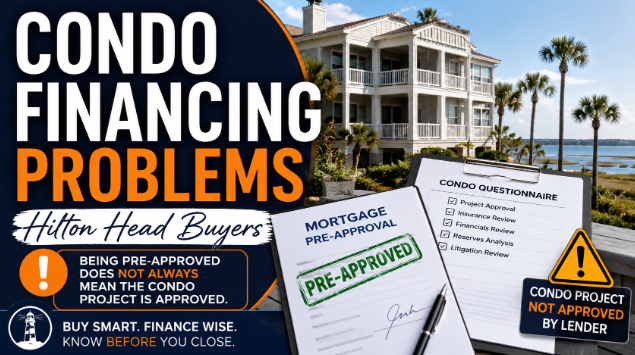
A mortgage pre-approval is important, but it does not fully solve condo financing.
A buyer can be financially strong and still run into trouble if the condo project itself does not fit the loan program. That is the part buyers often miss. They think the lender is only approving them. In reality, the lender may also need to approve the condo project.
That is why one Hilton Head condo may finance smoothly while another similar-looking unit creates issues. The difference may not be the buyer. It may be the association, insurance, litigation, rental structure, reserves, building condition, investor concentration, or project classification.
Sharp local-advisor line: the building has to make sense to the lender, not just the buyer.
This matters especially for Hilton Head condos and villas because buyers are often looking at second homes, vacation rentals, beach-oriented properties, older buildings, and properties with regime fees. Those features can be perfectly normal in this market, but they still need to be reviewed the right way.
Warrantable vs. Non-Warrantable Condos
A warrantable condo generally means the project fits standard conventional lending guidelines. A non-warrantable condo generally means the project does not fit those standard guidelines and may require a different financing path.
That does not always mean the property is a bad buy. It means the financing may be more limited.
A non-warrantable condo may require:
-
larger down payment
-
portfolio loan
-
local lender familiar with Hilton Head condo projects
-
higher rate or different terms
-
more cash reserves
-
cash buyer
-
longer review period
The key is not to guess. Do not assume a property is warrantable because other units sold recently. Do not assume it is non-warrantable because someone said "that building is tough." Get lender confirmation on the specific unit, building, loan type, and intended use.
Fannie Mae's project review framework includes eligibility factors such as project type, insurance, documentation, project completion, ownership structure, and other project-level details.
The Condo Questionnaire Can Make or Break the Loan
The condo questionnaire is one of the most important documents in condo financing.
This is where the lender may collect information about the association, the number of units, owner occupancy, investor ownership, insurance, reserves, litigation, special assessments, commercial space, building condition, and other project details.
Buyers often focus on the inspection, the appraisal, and the personal loan approval. Those matter. But for a Hilton Head condo, the condo questionnaire may be just as important.
A clean-looking unit with updated floors, nice furniture, and good photos can still create financing concerns if the questionnaire raises issues. On the other hand, an older-looking unit may still be financeable if the project itself is stable and fits the lender's guidelines.
That is why buyers should ask early:
-
Has this building had recent financed sales?
-
What type of loans have closed there recently?
-
Does the lender already know this regime?
-
Are there any known project-review concerns?
-
How long does the association or management company take to return lender documents?
Fannie Mae Form 1076 is the standard condominium project questionnaire used to collect project information, and lenders are encouraged to use it or a similar form in the loan file.
Condotel Issues Are a Real Hilton Head Concern
"Condotel" is one of those words buyers hear and immediately get confused.
Plain English version: a lender may become concerned if a condo project operates, looks, or functions too much like a hotel or resort instead of a residential condominium project.
That can come up when there are hotel-like services, daily rentals, rental pooling, central front desk operations, short-term transient use, restrictions on owner occupancy, required rental programs, or other features that make the project feel less like normal residential ownership.
On Hilton Head, this issue can matter because many buyers are looking at vacation-oriented properties. But there is an important distinction: not every short-term-rental condo is a condotel. Not every resort-area condo has a financing problem. The issue is property-specific and lender-specific.
Fannie Mae identifies hotel/motel-style project characteristics as potential ineligible project issues, including required rental pooling, restrictions on owner occupancy, short-term transient characteristics, hotel-type services, and resort/hotel-style operations.
Sharp local-advisor line: "condotel" is not a marketing label. It is a lender-risk issue.
That is why a cash buyer may be comfortable with a property that a conventional financed buyer cannot easily buy. It also explains why sellers need to understand the buyer pool. A property that requires cash or specialized financing may still sell, but it may need to be priced and marketed with that reality in mind.
Short-Term Rental Use Can Affect More Than Income
Many Hilton Head condo buyers are not just buying for personal use. They want some combination of personal use, vacation use, and rental offset.
That is normal here.
But rental potential has to be separated into several different questions:
Can the Town permit it?
Does the HOA or regime allow it?
Does the lender accept the project structure?
Does the insurance support the intended use?
Do the numbers still work after fees, management, cleaning, repairs, taxes, insurance, utilities, furnishings, and owner use?
The Town of Hilton Head requires a short-term rental permit for each STR property offered for short-term rental. The permit is separate from the annual business license, valid from May 1 through April 30, non-transferable, and tied to the specific property. The Town also moved to a $150-per-bedroom annual STR permit fee model with business license and ATAX compliance requirements.
That Town requirement is only one layer. Town approval is not the same thing as regime approval, and regime approval is not the same thing as lender approval.
This is where buyers get into trouble. They see rental history and assume the financing will be easy. But lenders may still review project characteristics, rental structure, investor concentration, insurance, and whether the building looks too hotel-like.
Insurance Can Change the Financing Conversation
Insurance is a big part of coastal condo ownership.
For a Hilton Head condo, the buyer may need to understand multiple layers of insurance: master policy, flood coverage, wind/hail exposure, building coverage, interior coverage, loss assessment exposure, and whatever the lender requires for the loan.
This can affect affordability and financing.
A buyer may qualify for the payment based on purchase price, but the final approval still depends on the full ownership cost and the lender's review of project insurance. If the association's master insurance is unclear, insufficient, expensive, changing, or difficult to document, that can slow down or complicate the loan.
South Carolina's Department of Insurance maintains coastal insurance resources, including information on mitigation credits, SC Safe Home, catastrophe savings accounts, and shopping for property insurance.
For Hilton Head buyers, the practical move is simple: involve the lender and insurance professionals early. Do not wait until the week before closing to discover that the building's master policy, flood policy, deductible structure, or coverage details need more review.
Special Assessments and Deferred Maintenance Can Spook Lenders
Special assessments are not automatically bad.
Sometimes an assessment means the association is taking care of needed work. That can be healthier than ignoring the building. But buyers and lenders need to understand what the assessment is for, how much remains, whether it is tied to critical repairs, and whether the issue has been resolved.
Fannie Mae's project standards address critical repairs and special assessments. Lenders may need to review what the assessment is for, when it was approved, how much remains, and when it is expected to be paid in full. If a special assessment is tied to an unresolved critical repair, the project may be ineligible.
This matters on Hilton Head because many condo buildings are older coastal properties. Roofs, elevators, balconies, railings, waterproofing, stairs, exterior systems, drainage, and insurance-related repairs can all become part of the ownership picture.
Sharp local-advisor line: the prettiest interior does not remove the need to understand the building.
A buyer should not panic just because there was an assessment. But they should know what the assessment means. Was it for routine capital work? Was it for serious deferred maintenance? Has the work been completed? Is more work expected? Are reserves strong enough for the next project?
Those answers can affect financing, resale, negotiations, and buyer confidence.
Litigation Can Create Financing Risk
Litigation is another issue buyers do not always expect.
An association may be involved in a dispute that has nothing to do with safety, structure, habitability, or financial stability. That may be manageable. But litigation tied to construction defects, structural issues, habitability, functional use, or major financial exposure can create financing problems.
Fannie Mae states that projects with certain pending litigation involving safety, structural soundness, habitability, or functional use may be ineligible, while some minor matters may be acceptable depending on the facts.
For buyers, the lesson is not "avoid every building with litigation." The lesson is to ask better questions and get the lender involved early. The lender, attorney, and association documents need to clarify whether the issue affects loan eligibility.
For sellers, this is also important. If there is known litigation or a known project concern, it is better to prepare the explanation and documents early than let the buyer discover it late in the process.
Investor Concentration and Owner Occupancy Can Matter
Hilton Head has many second-home, vacation-home, and investor-owned condos. That is part of the island's market.
But lenders may look at the ownership mix inside a project. If a project has heavy investor ownership, low owner occupancy, high single-entity ownership, or too much concentration in one ownership group, financing may become more complicated.
Fannie Mae lists single-entity ownership limits as one project eligibility issue and also identifies heavy investment/second-home ownership as a red flag in certain hotel/motel-style project reviews.
This does not mean vacation-rental buildings are automatically bad. Many buyers specifically want a rental-relevant building. But if you are financing, the lender needs to understand the project profile.
That is why two buyers can look at the same condo and have very different outcomes. A cash investor may see opportunity. A conventional financed buyer may need the building to pass a much stricter review.
FHA and VA Financing Can Be More Limited for Condos
Some buyers assume FHA or VA financing works the same way for condos as it does for houses.
It does not always work that way.
FHA and VA condo financing often depends on whether the condo project is approved or can be approved through the applicable process. HUD provides an official FHA-approved condominium search by location, name, status, and other filters.
VA condo financing also generally depends on project approval, and buyers should confirm the condo's status through VA-related tools or their lender before assuming the loan can work.
For Hilton Head, this matters because many condos are second-home, vacation, or investment-style properties. FHA and VA buyers should not wait until after falling in love with a unit to check whether that property type, project, and intended use fit the loan.
Second-Home vs. Investment Financing Matters
Another common problem is buyer intent.
A buyer may say, "I just want a place we can use and rent sometimes." That sounds simple, but lenders care how the property will actually be used.
Second-home financing and investment-property financing are not the same thing. Loan terms, down payment requirements, rate, underwriting, reserve requirements, rental-income treatment, and occupancy expectations may differ.
For Hilton Head buyers, this is especially important because many people want a blend: personal use, family use, and rental offset. That may be possible, but it needs to be discussed with the lender clearly.
Do not structure the loan around wishful thinking. If the goal is meaningful rental income, talk to a lender who understands second-home and investment condo financing in resort markets.
Sharp local-advisor line: the financing strategy should match the real use of the property, not the most convenient label.
Lower Price Does Not Always Mean Easier Financing
Buyers love a lower purchase price. Everyone does.
But on Hilton Head, a lower-priced condo can sometimes come with other tradeoffs: higher regime fees, older building issues, assessment risk, limited financing options, rental restrictions, insurance questions, dated condition, or smaller buyer pool on resale.
That does not mean lower-priced condos are bad. Some are smart buys for the right buyer. But the buyer has to understand why the property is priced where it is.
A cheaper condo that requires cash, has high fees, needs renovation, has limited rental ability, or sits in a harder-to-finance project may not be cheaper once you factor in total ownership cost.
This is where buyers should compare more than price.
They should compare:
-
purchase price
-
monthly regime fee
-
what the fee covers
-
insurance structure
-
known assessments
-
building condition
-
rental rules
-
financing eligibility
-
view and location
-
renovation needs
-
likely resale buyer pool
The right Hilton Head condo is not always the cheapest condo. It is the one that fits the buyer's use, budget, financing, rules, carrying costs, and long-term plan.
What Buyers Should Do Before Making an Offer
The safest approach is not to avoid condo financing. The safest approach is to verify the important pieces early.
Before making an offer, buyers should speak with a lender who understands Hilton Head condo and villa properties. Not every lender is equally comfortable with resort-area condo reviews, short-term rental buildings, master insurance questions, or non-warrantable project issues.
A buyer should also ask whether the lender has closed loans in that building or similar Hilton Head projects. Local experience can matter, especially when the property is in a beach, resort, older-building, or rental-heavy environment.
During due diligence, buyers should review the condo questionnaire, budget, master insurance, flood/wind information, reserve position, assessments, meeting minutes when available, litigation disclosures, rental rules, pet rules, parking rules, and management contacts.
The goal is not to make the process scary. The goal is to prevent late surprises.
What Sellers Should Understand Too
This is not only a buyer issue.
Sellers need to understand financing because it affects the buyer pool. If a condo is easy to finance, that can help buyer confidence. If a condo may require cash, portfolio lending, or a specialized lender, the seller needs to know that before pricing and marketing the property.
A seller should not wait for a contract to discover the building has financing concerns. It is better to prepare the documents early and understand what questions buyers and lenders may ask.
Useful seller prep may include:
-
current regime fee information
-
association contact information
-
master insurance contact
-
assessment information
-
recent project updates
-
rental history, if relevant
-
furniture inclusion list
-
known financing history in the building
-
any lender or association notes that may help explain the project
Buyers are not only comparing the condo to past sales. They are comparing it to what they can buy right now, how easily they can finance it, and how much uncertainty they have to accept.
Bottom Line
Condo financing on Hilton Head can be more complicated than buyers expect because the lender may review both the buyer and the condo project.
That is especially important in a market with beach condos, villa regimes, vacation rentals, older coastal buildings, insurance questions, assessments, and resort-style ownership structures.
The solution is not to assume every property has a problem. The solution is to verify early.
Before you get too attached to a Hilton Head condo, confirm the financing path, review the building, understand the regime, and make sure the property fits your real plan.
 FAQ
FAQ
Can every Hilton Head condo be financed?
No. Some Hilton Head condos may qualify for standard conventional financing, while others may require portfolio lending, non-QM options, larger down payments, or cash. Financing depends on the buyer, the condo project, the loan type, insurance, association documents, and lender review.
What is a non-warrantable condo?
A non-warrantable condo generally does not fit standard agency lending guidelines. That may be due to project characteristics such as insurance issues, litigation, investor concentration, condotel concerns, special assessments, commercial components, or other factors. Buyers should not label a condo warrantable or non-warrantable without lender verification.
Does short-term rental use make a condo harder to finance?
It can, depending on the building and loan program. Short-term rental activity by itself does not automatically kill financing, but heavy transient use, hotel-like operations, rental pooling, centralized rental programs, or resort-style project characteristics can raise lender concerns.
Can FHA or VA loans be used for Hilton Head condos?
Possibly, but the condo project needs to fit the applicable approval requirements. Buyers should check FHA or VA project status early and speak with a lender before assuming those loan types will work for a specific Hilton Head condo.
Why do lenders care about regime fees?
Regime fees affect affordability and may also reflect the building's insurance, reserves, maintenance, amenities, and management structure. A high fee is not automatically bad, and a low fee is not automatically good. The better question is what the fee covers and whether the association is financially prepared.
Should a buyer use a local lender for a Hilton Head condo?
It can help. A lender familiar with Hilton Head condo and villa projects may better understand regime documents, insurance questions, rental-heavy buildings, condotel concerns, and local project-review issues. The lender still needs to verify the specific property.
Questions About Financing a Hilton Head Condo?
Before you make an offer on a Hilton Head condo, make sure the financing path actually fits the property.
I help buyers look beyond the photos and compare the things that can affect the deal after the excitement wears off: financing, fees, insurance, rental rules, building condition, assessments, and resale considerations.
A great condo is not just one you like online. It is one that fits your use, your financing, and your long-term ownership plan.
Categories
- All Blogs (108)
- Hilton Head Condo Buyer Strategy (7)
- Beach Access & Coastal Ownership (1)
- Bluffton & Lowcountry Living (2)
- Bluffton Buyer / Seller / Comparison Topics (2)
- Bluffton Communities and Relocation (4)
- Bluffton Real Estate (8)
- Bluffton Real Estate / Relocation Guide (2)
- Buyer Advice (1)
- Buyer Guides (1)
- Costs, Fees, Insurance, Financing, and Due Diligence (1)
- Golf / Private Club / Gated Community Living (1)
- Golf / Private Club Communities (1)
- Hilton Head & Bluffton Buyer Strategy (1)
- Hilton Head Area Comparisons (1)
- Hilton Head Communities (4)
- Hilton Head Communities & Area Guides (11)
- Hilton Head Condo Buyer Guide (9)
- Hilton Head Condo Market Updates (1)
- Hilton Head Condo Seller Strategy (1)
- Hilton Head Condos & Villas (14)
- Hilton Head Homes (1)
- Hilton Head Homes + Island Living (2)
- Hilton Head Homes and Island Living (1)
- Hilton Head Real Estate (1)
- Hilton Head Seller Strategy (8)
- Hilton Head Short-Term Rental + Investment Guide (1)
- Hilton Head vs Bluffton (1)
- Hilton Head vs Bluffton / Relocation (3)
- Lowcountry Homeownership (1)
- Market Reports & Trends (4)
- Relocation and Retirement (1)
- Retirement & Relocation (1)
- Retirement and 55+ Communities (1)
- Retirement and Relocation (2)
- Retirement, 55+ & Private Club Living (3)
- Seller Strategy and Valuation (1)
- Short-Term Rentals & Investment (3)
Recent Posts
Should You Buy in Beaufort Instead of Hilton Head or Bluffton?

Hampton Hall vs Hampton Lake: Golf-Centered or Lake-Centered Living?

Multigenerational Living in Bluffton: The Floor Plan Matters More Than the Bedroom Count
Buying a Lowcountry Home With a Private Dock: What Buyers Need to Verify
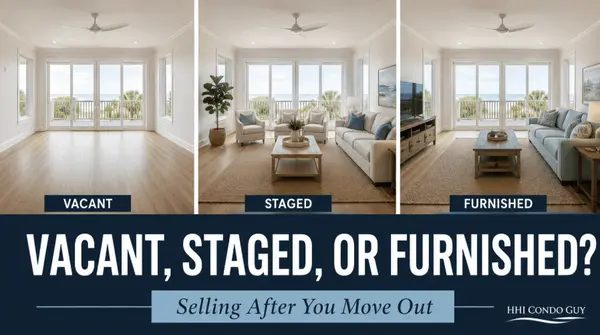
Selling After You Move Out: Vacant, Staged, or Left Furnished?
Flood Zone, Elevation, and Insurance: Why the House Next Door Can Carry a Different Risk

Septic vs Sewer in Bluffton and the Lowcountry: What Changes for the Buyer?

Buying a Stucco Home in the Lowcountry: What Buyers Should Investigate
Private Pool vs Community Pool: What Bluffton Buyers Are Really Choosing

Buying a Golf-Course Home When You Do Not Actually Golf