Builder Incentives in Bluffton: What Buyers Should Compare Beyond the Headline Discount
Builder Incentives in Bluffton: What Buyers Should Compare Beyond the Headline Discount
A builder advertises $50,000 in savings, a mortgage rate below 5%, or thousands of dollars toward closing costs. It looks like an easy decision.
It usually is not.
The incentive may apply only to one completed home. The low rate may be an adjustable-rate mortgage rather than a 30-year fixed loan. The closing-cost credit may require the builder's affiliated lender. The advertised price may not include the lot premium, structural options, community fees, or design selections that made the model home look so good.
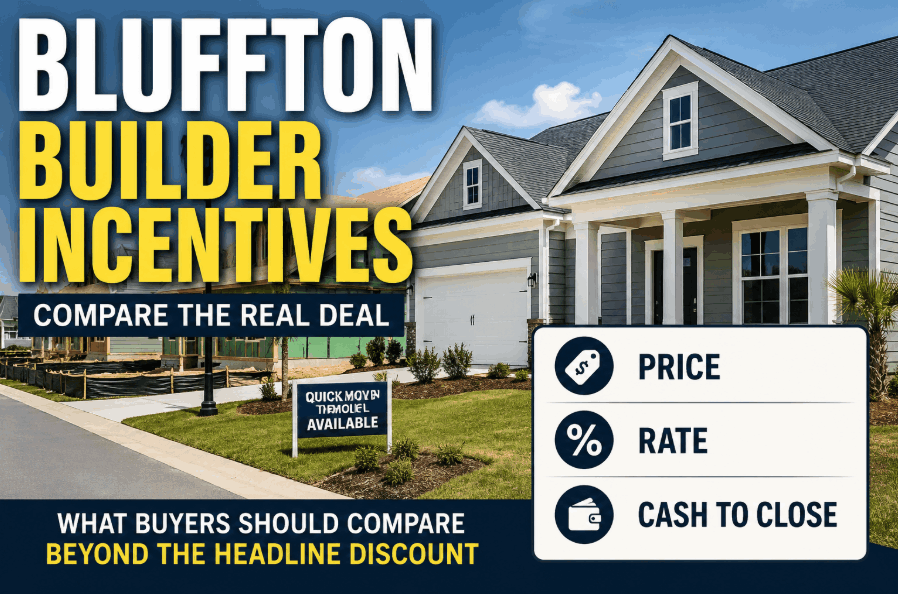
A builder incentive is not a discount until you know what it saves you, what it costs you, and what you give up to receive it.
These offers are common because affordability remains difficult. The national average 30-year fixed mortgage rate was 6.66% on July 30, 2026. In July, 63% of surveyed builders reported using sales incentives, while 37% had reduced prices.
That gives Bluffton buyers leverage, but it also creates a more complicated comparison. A large incentive package can make a new home financially attractive. It can also distract from a higher purchase price, a weaker homesite, an adjustable loan, limited lender choice, or costs that appear after the contract is signed.
The best offer is not necessarily the one with the biggest number. It is the one that produces the strongest combination of home, financing, cash required, ownership cost, and resale position.
Current Bluffton-Area Offers Show Why the Details Matter
A July 31, 2026 review of current Bluffton-area promotions shows how differently builders structure their offers.
Pulte was advertising a Bluffton quick move-in home with substantial price savings, a 4.99% fixed mortgage offer with a 5.388% APR, and up to 2% toward closing costs when using Pulte Mortgage. Dream Finders was advertising up to $54,000 in savings and a 4.99% rate with a 5.746% APR, but that financing example was a 7/6 adjustable-rate mortgage tied to select inventory and its affiliated lender. K. Hovnanian was advertising a 3.75% rate with a 5.162% APR on a 7/6 adjustable-rate mortgage or a flex-cash alternative for select Bluffton homes. Another K. Hovnanian Bluffton promotion allowed incentives to be applied toward financing, options, closing costs, or a price reduction, depending on the home and financing structure.
Lennar's current Hilton Head–Bluffton inventory also showed specific move-in-ready homes with significant price reductions while noting that promotions vary by community and homesite.
Those offers may all be valuable. They are not interchangeable.
One buyer may benefit most from preserving cash at closing. Another may care more about securing a fixed payment. A buyer expecting to stay for ten years may evaluate an adjustable-rate loan differently from someone expecting to move within five. A cash buyer may prefer a direct price reduction, while a financed buyer may receive more immediate benefit from a permanent rate buydown.
The headline gets your attention. The structure determines whether the offer works.
Current promotions, qualifying homes, rates, lender requirements, and closing deadlines can change quickly and should be confirmed in writing for the exact home.
Start With the Final Home Price, Not the Advertised Savings
The first number I would compare is not the incentive. It is the final contract price for the home you would actually buy.
That means the base price, homesite premium, structural options, design selections, elevation charge, appliance package, landscaping, screened porch, garage extension, and every other item being added to the contract.
A $500,000 base price can become a very different purchase after the right lot and the features you expected are included. A completed inventory home may already have those upgrades built into its price. A to-be-built home may require you to add them separately.
Some builder promotions also state that the advertised savings may already be reflected in the listed price. If that is the case, the buyer should not mentally subtract the incentive a second time.
Ask for a written price sheet showing:
The original price
Every lot and option charge
The current contract price
The incentive already included in that price
Any remaining credit available at closing
The purpose is not to argue over how the builder labels the promotion. The purpose is to determine what the finished home costs compared with the other homes you could buy.
A $40,000 "savings" package does not automatically make a $540,000 home a better purchase than a $500,000 alternative.
Identify Exactly What Kind of Mortgage Rate Is Being Advertised
A low builder rate can produce meaningful savings, especially when conventional mortgage rates are above 6%. It can be one of the strongest reasons to choose new construction.
But buyers need to distinguish among three very different products.
Permanent Fixed-Rate Buydown
A permanent buydown lowers the interest rate for the full loan term. The builder or lender normally pays discount points upfront to produce that lower rate.
This provides payment stability, but the buyer should still compare the loan's APR, origination charges, points, lender credits, and total cost against outside lenders.
Temporary Buydown
A temporary buydown reduces the buyer's payment during the first one to three years. The payment then increases until it reaches the loan's full note rate.
The Consumer Financial Protection Bureau specifically warns that mortgage payments can increase when a temporary buydown ends. The buyer should be comfortable with the full future payment without assuming that refinancing will be available.
Adjustable-Rate Mortgage
An adjustable-rate mortgage may keep the initial rate fixed for several years before allowing it to change.
For example, the current Dream Finders Bluffton-area promotion uses a 7/6 ARM. The advertised 4.99% rate is fixed for the first seven years and may then adjust according to the loan terms. Its example also excludes property taxes, homeowners insurance, and HOA fees from the advertised principal-and-interest payment.
A seven-year fixed period may work very well for some buyers. It should not be compared as though it were identical to a 30-year fixed mortgage.
The lowest payment on the brochure is not always the lowest-cost purchase.
Compare the APR, Loan Costs, and Five-Year Cost
The interest rate alone does not show the full financing cost.
Ask the builder's lender and at least one outside lender to provide Loan Estimates based on the same:
Home price
Down payment
Loan type
Loan term
Occupancy
Credit profile
Rate-lock date
The Consumer Financial Protection Bureau recommends comparing the monthly principal and interest, total estimated payment, origination charges, lender credits, cash to close, and the five-year cost shown on the Loan Estimate. Freddie Mac similarly recommends comparing the interest rate, APR, points, mortgage insurance, escrow estimates, and closing costs across lenders.
The builder's preferred lender may still produce the best offer after that comparison. Affiliated lenders can sometimes provide financing that an outside lender cannot match because the builder is funding the promotion.
The comparison is still necessary.
Suppose the builder's lender offers a large credit but charges more in origination fees. An outside lender may have a higher interest rate but lower fees. One offer may require substantially less cash at closing. Another may cost less over the five years you expect to own the home.
The right answer depends on your expected ownership period, available cash, loan structure, and comfort with future payment changes.
A Closing-Cost Credit Is Valuable Only When You Can Use It
Closing-cost assistance can be more useful than a price reduction for a buyer who wants to preserve cash for moving, furniture, window treatments, landscaping, or an emergency reserve.
But a builder credit is not always a check handed to the buyer.
The credit may be limited by the loan program, actual closing expenses, seller-contribution limits, or the builder's contract. It may be restricted to approved costs. It may disappear if the buyer switches lenders. It may not be convertible into a price reduction if part of the credit remains unused. Some current Bluffton builder promotions expressly state that contribution limits and affiliated-lender requirements can affect the benefit received.
Ask the lender to show exactly where the incentive appears on the Loan Estimate.
Then compare:
Estimated cash to close
Down payment
Lender fees
Closing attorney expenses
Prepaid taxes and insurance
Initial escrow funding
Mortgage insurance, when applicable
HOA or community charges due at closing
A $20,000 credit that can only cover $13,000 of eligible expenses should not be treated as $20,000 in usable savings.
Do Not Assign Full Dollar Value to Upgrades You Would Not Have Purchased
Builders may offer appliance packages, upgraded flooring, cabinets, countertops, patios, screened porches, blinds, landscaping, or design-center credits.
Those incentives can be useful, but their value is personal.
An upgraded appliance package is worth more to the buyer who planned to purchase those appliances immediately. A design credit is less valuable when the available selections do not match what the buyer wants. A $15,000 upgrade package does not necessarily add $15,000 to the home's future resale value.
A free upgrade is valuable only if you would have paid for it yourself.
Separate the upgrades into three categories:
First, improvements you need and would otherwise purchase after closing.
Second, improvements you prefer but could live without.
Third, items being added mainly because they are included in the promotion.
Then compare the builder's stated value against what it would cost to complete the work later. Also consider whether doing the work after closing would affect the builder warranty, require HOA approval, or create avoidable disruption.
The goal is not to reject upgrades. It is to stop counting every included feature as cash-equivalent savings.
The Homesite Attached to the Incentive Still Has to Make Sense
The strongest incentives are often tied to select quick move-in homes rather than every house in the community.
Current local promotions repeatedly limit savings to certain inventory, qualifying contracts, or required closing dates.
That means the homesite, floor plan, orientation, view, road exposure, yard, privacy, garage position, and selected finishes may already be decided.
A completed home with a large incentive may be a strong purchase when the property itself works. It becomes much less attractive when the buyer is accepting the wrong layout, a weaker lot, or expensive selections they would not have chosen.
A large incentive attached to the wrong home is not a better deal.
Closing deadlines also deserve attention. Some incentives require the buyer to close before a specified date. Buyers should have written clarification explaining what happens if construction is delayed, the certificate of occupancy is not issued, or the builder cannot complete the home before the promotional deadline.
Do not rely on a verbal promise that the incentive will "probably be extended."
Compare the New Build With the Best Resale Alternative
Bluffton buyers should not compare one builder only against another builder.
They should also compare the new home with the best resale homes available in the same general price range.
Start with the actual BLUFFTON HOMES that meet your location, layout, commute, community, and property needs. Then compare the new-construction package against what those resale alternatives offer.
A resale home may have mature landscaping, window treatments, fencing, established trees, a screened porch, storage improvements, appliances, and a larger or more private lot already included.
A new home may offer newer systems, current floor plans, energy-efficient construction, a builder warranty, fewer immediate repairs, and financing incentives that a resale seller may not be able to match.
Neither side automatically wins.
Bluffton residential buyers should compare the complete ownership experience: daily location, lot usability, HOA structure, storage, garage space, outdoor space, condition, future construction activity, community buildout, and how the property is likely to compete when it is eventually resold.
Builder incentives can make new construction more competitive. They do not erase differences in location, lot quality, community maturity, ownership costs, or resale competition.
The Five Comparisons I Would Put on One Page
Final Home Price
Use the complete contract price after the homesite, structural options, design selections, upgrades, and price incentives have been applied.
Do not compare a builder's base price with a finished resale home.
Financing
List the loan type, interest rate, APR, points, origination fees, mortgage insurance, rate-lock period, and whether the payment can change.
Clearly label fixed-rate, temporary-buydown, and adjustable-rate offers.
Cash Required
Compare the deposit, down payment, closing costs, prepaids, escrow funding, community charges, and estimated cash to close.
Then subtract only the builder credits that can actually be used.
The Property
Compare the floor plan, homesite, privacy, yard, garage, storage, included features, upgrade quality, completion date, warranty, and remaining work after closing.
The financing should not convince you to accept a property you would not otherwise choose.
Long-Term Position
Consider the full payment after any temporary or adjustable period, future HOA expenses, remaining neighborhood construction, expected ownership period, and how the home may compete against both future builder inventory and resales.
A builder can help you purchase the home. The builder cannot guarantee what the resale market will pay later.
My Bottom Line on Bluffton Builder Incentives
Builder incentives are real, and some current Bluffton-area offers are substantial. A strong rate buydown or closing-cost package can make a new home more affordable than a resale alternative.
The mistake is treating the advertised incentive as the entire decision.
Compare the final home, final contract price, loan type, APR, cash to close, future payment, homesite, included features, community costs, and resale competition. Get the preferred-lender offer in writing, then compare it with outside MORTGAGE OPTIONS using the same assumptions.
The best builder deal is not the largest advertised discount.
It is the home and financing package that still makes sense after every number is placed side by side.
Message me if you are comparing Bluffton builders, quick move-in homes, and resale alternatives and want help working through the actual numbers before signing.
Joel Androna
Real Broker, LLC
843-227-4649
 Frequently Asked Questions About Bluffton Builder Incentives
Are builder incentives negotiable?
Sometimes. Negotiating power usually depends on the specific home, current inventory, construction stage, sales pace, closing deadline, and whether the builder is trying to sell a completed home. Ask for specific changes such as a price reduction, permanent rate buydown, closing-cost assistance, appliances, HOA contributions, or additional upgrades rather than asking only whether the builder can "do better."
Is a low builder rate better than a price reduction?
It depends on the loan structure and how long you expect to own the home. A permanent fixed-rate buydown can create long-term payment savings. A temporary buydown mainly helps during the first few years. An adjustable-rate mortgage introduces future payment uncertainty. A price reduction lowers the contract price and potentially the loan balance. Compare both options over your expected ownership period.
Do I have to use the builder's preferred lender?
A buyer generally may choose another lender, but some or all of the builder's financing incentives may be available only through its affiliated or preferred lender. Current Bluffton-area promotions repeatedly include this requirement. Obtain written Loan Estimates from the preferred lender and outside lenders before deciding.
Can builder flex cash be used for anything?
Not necessarily. The contract may limit the credit to financing costs, approved upgrades, closing expenses, or a price reduction. Loan-program contribution limits can also restrict how much credit may be used. Ask for a written allocation showing exactly how the incentive will be applied.
Do builder incentives apply to every home?
Usually not. Many promotions apply only to selected quick move-in homes, specified communities, qualifying loan programs, or contracts that close before a deadline. The exact home and written contract terms control the offer.
Is new construction automatically a better value than a resale home?
No. New construction may offer stronger financing, newer systems, warranties, and modern layouts. A resale home may provide a better location, larger or more established lot, mature landscaping, completed improvements, and less construction activity. Compare the complete home and ownership cost rather than relying on age alone.
Categories
- All Blogs (108)
- Hilton Head Condo Buyer Strategy (7)
- Beach Access & Coastal Ownership (1)
- Bluffton & Lowcountry Living (2)
- Bluffton Buyer / Seller / Comparison Topics (2)
- Bluffton Communities and Relocation (4)
- Bluffton Real Estate (8)
- Bluffton Real Estate / Relocation Guide (2)
- Buyer Advice (1)
- Buyer Guides (1)
- Costs, Fees, Insurance, Financing, and Due Diligence (1)
- Golf / Private Club / Gated Community Living (1)
- Golf / Private Club Communities (1)
- Hilton Head & Bluffton Buyer Strategy (1)
- Hilton Head Area Comparisons (1)
- Hilton Head Communities (4)
- Hilton Head Communities & Area Guides (11)
- Hilton Head Condo Buyer Guide (9)
- Hilton Head Condo Market Updates (1)
- Hilton Head Condo Seller Strategy (1)
- Hilton Head Condos & Villas (14)
- Hilton Head Homes (1)
- Hilton Head Homes + Island Living (2)
- Hilton Head Homes and Island Living (1)
- Hilton Head Real Estate (1)
- Hilton Head Seller Strategy (8)
- Hilton Head Short-Term Rental + Investment Guide (1)
- Hilton Head vs Bluffton (1)
- Hilton Head vs Bluffton / Relocation (3)
- Lowcountry Homeownership (1)
- Market Reports & Trends (4)
- Relocation and Retirement (1)
- Retirement & Relocation (1)
- Retirement and 55+ Communities (1)
- Retirement and Relocation (2)
- Retirement, 55+ & Private Club Living (3)
- Seller Strategy and Valuation (1)
- Short-Term Rentals & Investment (3)
Recent Posts