Downsizing to the Lowcountry: Why Less Square Footage Does Not Always Mean an Easier Move
Downsizing to the Lowcountry: Why Less Square Footage Does Not Always Mean an Easier Move
A lot of people begin a Lowcountry downsizing search with a square-footage target.
They may be leaving a 3,000-square-foot home and decide the next property should be 1,500 square feet. That sounds logical. Fewer rooms should mean less cleaning, less maintenance, lower expenses, and a simpler life.
Sometimes it does.
But I have also seen buyers trade unused space for a home that creates new frustrations: nowhere to store their belongings, no comfortable place for guests, a layout that does not work, stairs they did not want, higher association fees, less parking, or a location that makes daily errands harder.
Square footage tells you how much enclosed space you own. It does not tell you how much work the property will create.
A successful downsizing move should reduce ownership friction without removing the parts of the home you still use.
Downsizing Is Not a Square-Footage Contest
There is no single Lowcountry definition of a downsized home.
Current floor plans in local active-adult communities illustrate how broad the category can be. Latitude Margaritaville Hilton Head advertises cottage plans beginning around 1,210 air-conditioned square feet, while its larger single-family plans exceed 2,500 square feet. Sun City Hilton Head also offers single-level plans around 1,357 square feet with two bedrooms, two bathrooms, and a two-car garage.
Those homes can all be described as retirement-oriented or downsizing-friendly, but they create very different daily experiences.
A well-designed 1,700-square-foot home with a garage, pantry, usable closets, laundry room, guest bedroom, and single-level layout may be easier to live in than a 1,100-square-foot condo with limited storage and a long walk from the parking area.
The easiest home is not always the smallest. It is the home that asks the least of you without taking away what you still use.
The Hardest Part May Happen Before the Move
Downsizing often requires more preparation than a normal move because you are not simply transferring your belongings. You are deciding which belongings still belong in your life.
AARP recommends beginning early, working from an actual floor plan, and measuring the new home before deciding which furniture to keep. The organization also notes that reducing what you move can lower moving costs because movers may charge partly according to shipment weight.
That process becomes harder when someone has lived in the same house for 20 or 30 years. The garage may hold tools, holiday decorations, bicycles, old furniture, family belongings, and boxes that have not been opened in a decade. Extra bedrooms may have quietly become storage rooms.
The move can also carry more emotion than expected. You may be leaving the house where children grew up, where holidays were held, and where decades of routines were built. Sorting through that history under a closing deadline is rarely easy.
Starting early gives you the ability to make decisions instead of simply reacting to moving day.
The Sale and Purchase Have to Work Together
The belongings are only one part of the transition. Buyers also have to coordinate the sale of the current home with the purchase of the next one.
Selling first may provide a clearer budget, but it can create temporary housing and storage needs. Buying first may make the physical move easier, but it can require enough cash or financing to carry two properties temporarily.
Some homeowners prepare their current home for sale before they have identified the next property. Others find a smaller home and then discover they cannot list their existing house quickly enough without accepting a rushed timeline.
The smoothest move usually begins with a plan for both properties. The home search, decluttering, repair work, financing, listing preparation, and moving schedule should be considered together rather than treated as separate projects.
A Smaller Home Can Keep Many of the Same Responsibilities
Reducing square footage does not automatically remove exterior maintenance.
A smaller detached home can still have a roof, HVAC system, yard, irrigation, gutters, driveway, windows, exterior paint, drainage, pest control, and landscaping. The cost may be lower than maintaining a much larger house, but the responsibility still belongs to the owner unless the community provides specific services.
A condo or townhome may transfer some exterior responsibilities to an association. That can make the property easier to leave for extended periods and may remove certain repair decisions from the owner's calendar.
The tradeoff is that maintenance does not disappear. It becomes part of the association structure.
Owners still need to understand what the fees include, what remains their responsibility, whether reserves are adequate, whether major projects are planned, and how assessments could affect future costs.
Downsizing works when you remove ownership friction, not merely rooms.
Layout and Storage Matter More Than the Number on the Listing
A smaller home can live comfortably when its space is usable.
An open living area may replace separate formal rooms that were rarely used. A den can handle work, hobbies, or overflow guests. A large pantry can eliminate the need for several kitchen cabinets. A well-planned garage can replace an attic, basement, and outdoor shed.
The opposite is also true. A poorly arranged home can feel cramped even when the total square footage appears reasonable.
This matters in the Lowcountry because many buyers arrive with equipment that needs a home. They may own bicycles, golf clubs, beach chairs, fishing equipment, kayaks, tools, holiday decorations, luggage, outdoor furniture, or a golf cart.
A property can have enough room for two people and still lack enough room for the way those two people live.
Guest space deserves the same attention. A room that sits empty most of the year may appear wasteful, but eliminating it completely can create a problem when children, grandchildren, or friends visit.
Do not trade unused rooms for daily frustration.
Before deciding how much space to remove, decide which functions the next home still needs to perform.
Smaller Does Not Automatically Mean Less Expensive
A downsized property can reduce utility bills and routine upkeep, but purchase price is only one part of the calculation.
A smaller property in a premium location may cost more than a larger property farther inland. A condo may reduce individual exterior maintenance while adding a substantial monthly fee. A new home may have fewer immediate repairs but require upgrades, window treatments, landscaping, or new furniture.
The comparison should include:
Purchase price and financing
Property taxes
Insurance
HOA, POA, or condo fees
Known or possible assessments
Utilities
Lawn and exterior maintenance
Storage expenses
Renovations or accessibility changes
The cost of replacing furniture that does not fit
Travel and transportation from the new location
A full-time move can also change the property-tax calculation. Beaufort County states that an approved legal residence receives a 4% assessment ratio, while other residential property is generally assessed at 6%. Buyers should confirm the application requirements and estimate the tax bill for the specific property rather than relying on the seller's current bill.
A downsizing decision should be judged by total monthly cost and the work attached to the property, not only by purchase price or square footage.
The Lowcountry Adds Ownership Questions That Do Not Shrink With the House
Coastal conditions still matter when the home is smaller.
Warm, humid conditions make HVAC operation, ventilation, water intrusion, and moisture management important. Clemson University notes that controlling indoor moisture and responding quickly to leaks can reduce the likelihood of mold and mildew growth.
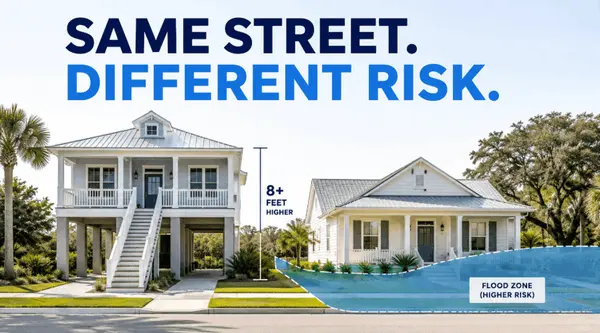
Flood risk is also property-specific. The Town of Hilton Head Island and Beaufort County provide FEMA-based flood-map tools, while FEMA explains that flood insurance is generally separate from a standard homeowners policy.
That does not mean every Lowcountry home carries the same risk or insurance requirement. It means a smaller footprint does not remove the need to investigate the property's location, elevation, flood zone, drainage, insurance options, and construction.
A small detached home with a demanding yard, older roof, moisture issue, and drainage concerns may require more attention than a somewhat larger home with a healthier structure and a better maintenance arrangement.
Size cannot compensate for a property that is difficult to own.
Choose the Ownership Structure Before Choosing the Size
Lowcountry downsizers often compare three broad options, and each one simplifies a different part of ownership.
A buyer considering HILTON HEAD CONDOS may be prioritizing lock-and-leave convenience, proximity to island activities, and less individual exterior maintenance. That buyer still needs to compare fees, reserves, insurance, building condition, parking, elevator access, storage, rules, and the responsibilities assigned to the individual owner.
A buyer looking at BLUFFTON HOMES may gain a garage, private outdoor space, easier storage, and a more traditional residential layout. The tradeoff may be greater responsibility for the roof, yard, exterior, driveway, drainage, and other individual systems.
Buyers comparing 55+ COMMUNITIES may find single-level layouts, community amenities, organized activities, and housing designed around retirement or part-time use. But the homes, fees, rules, lot arrangements, locations, and maintenance responsibilities can vary substantially from one community to another.
None of these options is automatically easier.
The ownership structure has to match the way you want to spend your time, money, and energy.
Test the Home Against an Ordinary Tuesday
Buyers often evaluate downsizing homes while imagining vacations, visiting family, golf, boating, restaurants, and time at the beach.
Those experiences matter, but most ownership happens on ordinary days.
Think about where groceries will go, where the vacuum will be stored, how far you will carry packages from the car, whether the laundry is convenient, where guests will sleep, and whether you can comfortably work or pursue hobbies without taking over the dining table.
Consider whether the primary bedroom and bathroom will remain practical over time. Look at steps, thresholds, shower access, door widths, lighting, and the distance between the garage, kitchen, and living areas.
A property that works beautifully during a showing can become frustrating when small inconveniences are repeated every day.
The right downsizing home should make an ordinary Tuesday easier.
Decide What You Are Actually Trying to Simplify
People downsize for different reasons.
Some want fewer repairs. Some want a one-level layout. Others want to release equity, travel more, move closer to family, reduce yard work, live near healthcare, or spend more time using the amenities around them.
Those goals can point toward different properties.
If the priority is travel, a well-managed condo or low-maintenance community may be attractive. If the priority is hobbies and storage, a slightly larger home with a garage may work better. If the priority is accessibility, layout may matter more than community amenities. If the priority is reducing monthly expenses, the complete carrying cost needs to be calculated before assuming the smaller option will save money.
A buyer who knows exactly what should become easier can evaluate properties much more clearly.
A buyer who is only chasing less square footage may end up moving twice.
My Advice for Downsizing to the Lowcountry
Start with the life you expect to live, not the size of the home you are leaving.
Identify the rooms and storage areas you currently use. Measure the furniture you genuinely want to keep. Decide how often guests will stay, whether you still want a garage, and which activities require equipment or dedicated space.
Then compare the actual responsibilities attached to each property.
Who handles the roof? Who handles the exterior? Is lawn service included? What do the association fees cover? Is there adequate storage? Are there stairs? How does parking work? What is the flood profile? What would the insurance cost? How far is the property from the places you will use regularly?
Less space can absolutely create more freedom.
It only works when the new property removes more problems than it creates.
Message me if you are comparing Hilton Head, Bluffton, or Lowcountry downsizing options and want help evaluating the actual properties instead of relying on square footage alone.
Joel Androna
HHI Condo Guy
843-227-4649
 Frequently Asked Questions About Downsizing to the Lowcountry
Does downsizing always reduce housing expenses?
No. A smaller home may reduce utilities and some maintenance, but the final cost depends on purchase price, location, insurance, property taxes, association fees, assessments, renovations, storage, and the responsibilities included with the property.
Is a condo always easier to maintain than a house?
A condo may remove some individual exterior responsibilities, but owners still need to evaluate the building, association finances, fees, reserves, insurance, assessments, parking, storage, elevators, and unit-level maintenance. Easier maintenance depends on the specific property and association.
How much square footage should a downsizing buyer look for?
There is no universal target. Start with the functions the next home must provide: everyday living, storage, guests, hobbies, work, parking, and accessibility. A well-designed home may live better than a larger property with wasted space or a smaller property with a poor layout.
Should I sell my current home before buying in the Lowcountry?
That depends on financing, available cash, the condition of the current home, the availability of suitable replacement properties, and whether temporary housing would be acceptable. The sale and purchase timelines should be planned together before either transaction is rushed.
Are 55+ communities automatically low maintenance?
Not necessarily. They may offer single-level homes, amenities, organized activities, or certain maintenance services, but fees, rules, exterior responsibilities, lot care, and home designs differ. Buyers should confirm exactly what is included in each community.
Categories
- All Blogs (108)
- Hilton Head Condo Buyer Strategy (7)
- Beach Access & Coastal Ownership (1)
- Bluffton & Lowcountry Living (2)
- Bluffton Buyer / Seller / Comparison Topics (2)
- Bluffton Communities and Relocation (4)
- Bluffton Real Estate (8)
- Bluffton Real Estate / Relocation Guide (2)
- Buyer Advice (1)
- Buyer Guides (1)
- Costs, Fees, Insurance, Financing, and Due Diligence (1)
- Golf / Private Club / Gated Community Living (1)
- Golf / Private Club Communities (1)
- Hilton Head & Bluffton Buyer Strategy (1)
- Hilton Head Area Comparisons (1)
- Hilton Head Communities (4)
- Hilton Head Communities & Area Guides (11)
- Hilton Head Condo Buyer Guide (9)
- Hilton Head Condo Market Updates (1)
- Hilton Head Condo Seller Strategy (1)
- Hilton Head Condos & Villas (14)
- Hilton Head Homes (1)
- Hilton Head Homes + Island Living (2)
- Hilton Head Homes and Island Living (1)
- Hilton Head Real Estate (1)
- Hilton Head Seller Strategy (8)
- Hilton Head Short-Term Rental + Investment Guide (1)
- Hilton Head vs Bluffton (1)
- Hilton Head vs Bluffton / Relocation (3)
- Lowcountry Homeownership (1)
- Market Reports & Trends (4)
- Relocation and Retirement (1)
- Retirement & Relocation (1)
- Retirement and 55+ Communities (1)
- Retirement and Relocation (2)
- Retirement, 55+ & Private Club Living (3)
- Seller Strategy and Valuation (1)
- Short-Term Rentals & Investment (3)
Recent Posts