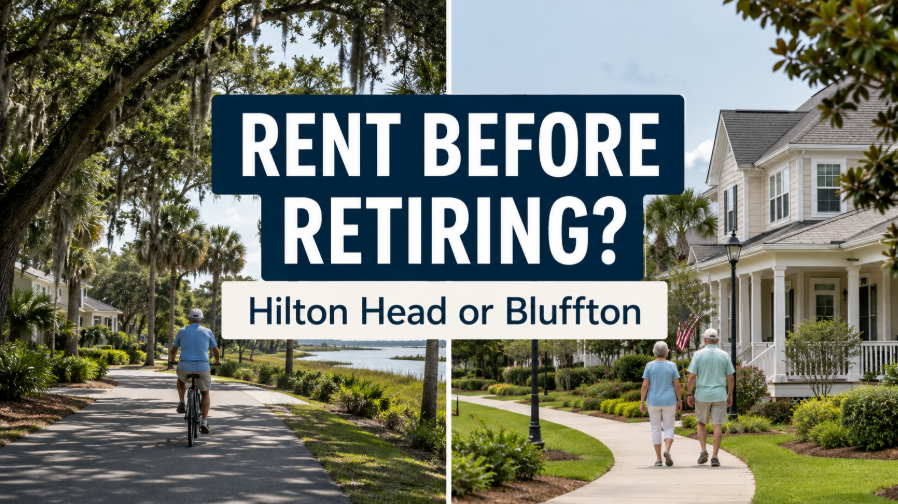
Should You Rent for a Season Before Retiring to Hilton Head or Bluffton?
Should You Rent for a Season Before Retiring to Hilton Head or Bluffton?
A week on Hilton Head can make retirement feel like an easy decision. You bike to breakfast, spend the afternoon near the water, go out for dinner, and start wondering why you are going home at all.
But retirement is not a vacation repeated forever.
It is groceries on a Tuesday, a doctor's appointment, summer traffic, insurance renewals, visitors, home maintenance, humidity, community rules, and deciding whether you still like the location after the novelty wears off.
That is why renting for a season before buying can be valuable. The rental gives you time to experience the area without immediately committing to a house, condo, neighborhood, or active-adult community.
The rental only helps, however, when it resembles the retirement you are actually considering. Renting an oceanfront condo for three weeks while planning to buy a single-family home in Sun City may confirm that you enjoy visiting the coast. It does not tell you how your future home or daily routine will work.
A good trial stay should replace assumptions with evidence.
For Many Retirees, Renting First Is Worth It
Renting first makes the most sense when you are still deciding between Hilton Head and Bluffton, between a condo and a house, or between a traditional residential community and a dedicated 55-plus community.
Those choices create very different retirement experiences.
Hilton Head may appeal to someone who wants island scenery, established residential communities, biking, beach access, restaurants, boating, golf, or the possibility of a lower-maintenance condo. Bluffton may appeal to someone who wants a newer home, more garage and storage space, a larger selection of active-adult communities, easier mainland errands, or a neighborhood designed around full-time residents.
Neither option is automatically better. They simply solve different daily-life problems.
Renting gives you time to learn which problems actually matter to you. You may discover that being close to the beach is worth giving up some space. You may decide the island feels better during vacation than it does during ordinary errands. You may learn that the organized social calendar inside a large active-adult community is far more important than you expected.
The right seasonal rental does not delay the decision. It helps prevent an expensive decision based on the wrong version of the area.
A Hilton Head Vacation Is Not the Same as Hilton Head Retirement
Visitors tend to experience Hilton Head when their schedule is flexible. They can avoid busy roads, eat at unusual times, ride bikes instead of driving, and treat a crowded beach or restaurant as part of the trip.
Residents still have places they need to be.
The Town uses July conditions when analyzing peak travel impacts, and its beach-parking program has a defined peak season running from March 1 through early September. Resident parking privileges also operate differently from visitor parking. Those may look like small details, but they affect how convenient island life feels once the beach becomes part of your routine rather than the main event of your vacation.
A summer rental can show you whether you are comfortable with tourism traffic, busier restaurants, beach parking, heat, humidity, and the pace of the island during its active season.
A winter rental shows a different side. The island is quieter, some services operate differently, and the beach may become more of a backdrop than a daily activity. That can help you decide whether you enjoy Hilton Head itself or mainly enjoy the vacation season.
Do not buy the retirement version you experienced on vacation. Buy the one that still works on an ordinary Tuesday.
Bluffton Is Not Simply the Practical Backup
Some buyers begin with Hilton Head and treat Bluffton as the place they will consider only if island prices, space, or inventory become a problem.
That misses why many retirees choose Bluffton on purpose.
Bluffton offers traditional neighborhoods, private golf communities, newer subdivisions, larger homes, townhomes, and several different versions of active-adult living. It also places residents closer to many mainland shopping, medical, and service destinations.
The tradeoff is that Bluffton is growing, and daily life can be heavily influenced by where you live in relation to U.S. 278, Bluffton Parkway, Buckwalter Parkway, bridges, shopping areas, and the places you regularly visit. Bluffton's adopted transportation planning identifies U.S. 278 as its highest-traffic corridor, which is precisely why testing your actual routes matters more than studying a map.
Bluffton's active-adult options also differ substantially from one another. Sun City Hilton Head reports more than 18,000 residents and over 100 chartered clubs and registered community groups. That scale creates an extensive built-in social system, but it also means buyers should experience the community rather than judging it only by an amenity list.
Latitude Margaritaville Hilton Head is located in Hardeeville, not on Hilton Head Island, and the community offers a "Change in Latitude Getaway" designed to let prospective residents stay in a furnished home and use community amenities. That type of program can provide useful exposure to the community, although it should still be treated as a preview rather than a complete picture of ownership.
Retiring to Bluffton is not merely choosing the mainland. It is choosing how much community structure, space, convenience, driving, maintenance, and organized activity you want in your daily life.
Rent Where You Might Actually Buy
The biggest mistake with a trial rental is choosing the most enjoyable property instead of the most useful one.
A beachfront rental can be wonderful, but it does not help much when your likely purchase is a residential home several miles from the beach. A furnished cottage in Old Town Bluffton will not show you what living in a large gated community feels like. A stay inside an active-adult community may not answer your questions about living in a mixed-age neighborhood.
The rental should imitate ownership, not celebrate the destination.
If You Think You Want Hilton Head
Stay in the part of the island and the property type you are seriously considering.
A condo near the beach creates a different routine from a home inside Hilton Head Plantation, Indigo Run, Port Royal, Sea Pines, or another residential community. Condo living can reduce some exterior-maintenance responsibilities, but fees, shared-building decisions, parking, storage, elevators, pet rules, rental activity, and association finances may become part of the ownership experience.
A Hilton Head house may provide more privacy, storage, garage space, and separation from vacation traffic, but it can also create more direct responsibility for landscaping, exterior maintenance, insurance, storm preparation, and repairs.
Spend time looking at HILTON HEAD HOMES that resemble the property you would realistically purchase. The purpose is not to fall in love with the nicest rental available. It is to determine whether the location, housing type, and routine still make sense after several normal weeks.
If You Think You Want Bluffton
Stay near the communities and roads you are likely to use.
Test the drive to groceries, restaurants, medical appointments, the airport, the island, Savannah, family, golf, church, or any activity that will be part of your week. A community can look close to everything on a map while still creating a routine that depends heavily on one congested corridor.
Compare actual BLUFFTON HOMES rather than assuming every mainland neighborhood provides the same experience. Old Town, Buckwalter, established gated communities, new-construction neighborhoods, and communities closer to Hardeeville or Okatie can differ in home age, lot size, fees, amenities, traffic patterns, and the amount of driving required.
Bluffton works best when the location makes your ordinary errands easier, not merely when the house gives you more square footage.
If You Are Comparing Active-Adult Communities
A trial stay should test the community culture as much as the house.
Attend activities. Use the fitness facilities. Talk with residents. Drive through the gates at different times. Find out whether the clubs you care about are active, whether activities require additional fees, and whether the scale of the community feels energizing or overwhelming.
Then compare the experience with other BLUFFTON 55+ COMMUNITIES. A large established community, a smaller active-adult neighborhood, and a new lifestyle-branded development may all advertise recreation and social activity, but the daily experience can be very different.
The house matters. The system around the house may matter just as much.
Test the Area During a Less-Flattering Season
Do not evaluate a retirement destination only when it is behaving at its best.
Spring weather can make nearly every Lowcountry location feel easy. The more revealing test may be summer, when heat, humidity, storms, tourism, air-conditioning use, insects, and traffic become harder to ignore.
South Carolina publishes an updated hurricane guide each year and encourages residents to know their evacuation zones and prepare a storm plan. A trial stay does not need to occur during a storm, but retirees should understand what coastal preparation, evacuation planning, insurance, and extended power outages could mean for the property and location they are considering.
Winter can also be useful. It shows you the area without peak beach activity and reveals whether you still enjoy the community when outdoor routines, visitors, and restaurant traffic slow down.
When possible, rent across a seasonal transition. Eight weeks from late spring into summer or from late fall into winter will teach you more than eight weeks during a single predictable weather pattern.
The goal is not to find perfect weather. The goal is to learn which inconveniences you are willing to live with.
Use the Rental to Test a Normal Tuesday
A seasonal stay becomes useful when you stop behaving like a visitor.
Cook at home. Buy groceries. Schedule routine appointments. Drive during normal traffic periods. Spend several days without going to the beach. See how often you actually use the amenities that influenced your search.
Pay attention to how much driving is required. Hilton Head has seasonal trolley service and extensive pathways, but most retirees still need to determine whether their exact location works with their transportation needs. Bluffton also has regional transit options, but the usefulness of any service depends on the specific route, schedule, and destination.
Healthcare should be tested with the same level of specificity. Novant Health describes Hilton Head Medical Center as a 93-bed hospital serving communities from Hilton Head to Bluffton. Beaufort Memorial operates primary care and express-care services in Bluffton, along with additional facilities in the surrounding area.
Those facilities may provide convenient local care, but your decision should be based on your own doctors, specialists, prescriptions, hospital preferences, insurance network, and likely future needs.
Do not ask only, "Is there a hospital nearby?"
Ask how long it takes to reach the exact care you are likely to use, whether your specialists are local, and whether regular trips to Savannah, Beaufort, or Charleston would be acceptable.
Keep a Retirement Budget, Not a Vacation Budget
A seasonal rental can reveal grocery costs, dining habits, gasoline use, utility patterns, and how much you spend on activities.
It cannot fully reproduce ownership costs.
The landlord may be paying the property taxes, insurance, association fees, landscaping, pest control, major repairs, appliance replacement, and building expenses. A furnished rental may also include utilities, internet, furniture, household supplies, or maintenance that you would eventually pay yourself.
Before buying, create a separate ownership budget for each property you are considering. Include the mortgage if applicable, property taxes, homeowner or condo insurance, flood and wind coverage when needed, HOA or POA fees, condo regime fees, club costs, utilities, exterior maintenance, pest control, storm preparation, repairs, and future replacement of major systems.
Beaufort County's four-percent legal-residence classification requires the property to be owned and occupied as the applicant's legal residence, along with supporting residency documentation. South Carolina also offers certain retirement-income, age-based, Social Security, and homestead provisions, but eligibility depends on the individual taxpayer and should be reviewed with the appropriate tax professional and government office.
A seasonal rental tells you how the area feels. It does not tell you what a particular home will cost to own.
What Renting First Will Not Tell You
A rental has limits.
You are not responsible for the building, roof, drainage, landscaping, association finances, insurance renewals, or future repairs. You may be staying in a professionally furnished property that is easier to maintain than the home you eventually buy.
You may also become attached to a neighborhood where suitable homes rarely come available. Prices, mortgage rates, builder incentives, insurance requirements, and inventory can change while you are renting.
That does not make the trial period a mistake. It means the rental should run alongside the real estate search.
Use the stay to tour properties, compare communities, read governing documents, request insurance estimates, understand fees, and narrow the purchase criteria. By the end of the rental, you should know more than whether you enjoyed the area. You should know which type of property you want, which communities remain under consideration, and what ownership costs you are willing to accept.
When You May Not Need to Rent First
Renting is not mandatory for every retiree.
You may be ready to buy when you have already spent extended time here during different seasons, understand the difference between island and mainland living, have narrowed the search to a specific community or property type, and have verified the ownership costs.
You may also have a strong practical reason to buy immediately, such as a job transition, a family move, the sale of your current home, a limited community preference, or a property that solves a very specific long-term need.
The important distinction is whether you are buying from familiarity or from vacation excitement.
Someone who has spent several months on Hilton Head over multiple years is making a different decision from someone who has visited twice for summer vacation. Someone who has friends inside a Bluffton community and already participates in its activities may need less testing than someone choosing from online videos and builder brochures.
Renting first is most valuable when the decision still contains major unknowns.
How Long Should the Trial Stay Be?
A few weeks can help, but six to twelve weeks usually creates a more realistic routine.
For Hilton Head, stays of fewer than 30 days fall under the Town's short-term-rental framework. Longer rentals may provide a more residential rhythm, although lease rules, community restrictions, pet policies, parking, and minimum rental periods still need to be verified for the specific property.
When the decision is still Hilton Head versus Bluffton, consider dividing the trial between the two areas. Spend enough time in each location to establish routines rather than moving every few days.
When the location is already settled, stay in one area and test it deeply. Drive the roads, use the amenities, meet residents, tour homes, track expenses, and see how the community feels after the first several weeks.
A trial stay should produce a decision, not just another pleasant memory.
My Recommendation
Rent first when you have mainly experienced the Lowcountry as a visitor, when you and your spouse are drawn to different options, or when you are still comparing island living, mainland convenience, active-adult communities, condos, and single-family homes.
Skip the rental only when you have already done the work another way.
The strongest approach is usually a stay of at least six weeks in the type of property and general location you might buy. Live normally, track expenses, tour homes, test your routes, and experience at least one part of the year that is less convenient than the week you would normally choose for vacation.
Hilton Head and Bluffton can both be excellent places to retire. The better decision depends on the home, the community, the routine, the costs, and the amount of responsibility you want to carry into retirement.
The rental should answer one question:
Does this still work when I stop treating it like a trip?
Message me if you are trying to compare Hilton Head, Bluffton, or the area's active-adult communities and want help narrowing the actual properties.
— Joel, The HHI Condo Guy
 Frequently Asked Questions
Should I rent before retiring to Hilton Head?
Renting first is usually worthwhile when your experience with Hilton Head has mainly been through vacations. A longer stay can reveal traffic patterns, weather, errands, medical access, community rules, housing choices, and whether island living still appeals to you during an ordinary week.
Should I rent in Bluffton before buying in a 55-plus community?
Yes, especially when the community's activities, size, social culture, gates, fees, and location are major reasons for buying. Try to stay inside the community or use an official trial-stay program rather than renting elsewhere in Bluffton and assuming the experience will be the same.
How long should I rent before deciding?
Six to twelve weeks is a useful target. A longer stay gives the vacation feeling time to wear off and allows you to establish routines. Crossing from one season into another can make the test even more useful.
Should I split my rental between Hilton Head and Bluffton?
Splitting the stay can help when the island-versus-mainland decision remains unresolved. Spend enough time in each place to live normally. Very short stays can turn the comparison into two vacations rather than two retirement tests.
Will renting show me the complete cost of retirement?
No. A rental may reveal daily spending, but it will not fully reproduce property taxes, insurance, HOA or regime fees, major maintenance, repairs, storm preparation, club expenses, and future replacement costs. Build a separate ownership budget for every property you seriously consider.
Categories
- All Blogs (108)
- Hilton Head Condo Buyer Strategy (7)
- Beach Access & Coastal Ownership (1)
- Bluffton & Lowcountry Living (2)
- Bluffton Buyer / Seller / Comparison Topics (2)
- Bluffton Communities and Relocation (4)
- Bluffton Real Estate (8)
- Bluffton Real Estate / Relocation Guide (2)
- Buyer Advice (1)
- Buyer Guides (1)
- Costs, Fees, Insurance, Financing, and Due Diligence (1)
- Golf / Private Club / Gated Community Living (1)
- Golf / Private Club Communities (1)
- Hilton Head & Bluffton Buyer Strategy (1)
- Hilton Head Area Comparisons (1)
- Hilton Head Communities (4)
- Hilton Head Communities & Area Guides (11)
- Hilton Head Condo Buyer Guide (9)
- Hilton Head Condo Market Updates (1)
- Hilton Head Condo Seller Strategy (1)
- Hilton Head Condos & Villas (14)
- Hilton Head Homes (1)
- Hilton Head Homes + Island Living (2)
- Hilton Head Homes and Island Living (1)
- Hilton Head Real Estate (1)
- Hilton Head Seller Strategy (8)
- Hilton Head Short-Term Rental + Investment Guide (1)
- Hilton Head vs Bluffton (1)
- Hilton Head vs Bluffton / Relocation (3)
- Lowcountry Homeownership (1)
- Market Reports & Trends (4)
- Relocation and Retirement (1)
- Retirement & Relocation (1)
- Retirement and 55+ Communities (1)
- Retirement and Relocation (2)
- Retirement, 55+ & Private Club Living (3)
- Seller Strategy and Valuation (1)
- Short-Term Rentals & Investment (3)
Recent Posts