What Salt Air, Humidity and Long Absences Do to a Lowcountry Home
What Salt Air, Humidity and Long Absences Do to a Lowcountry Home
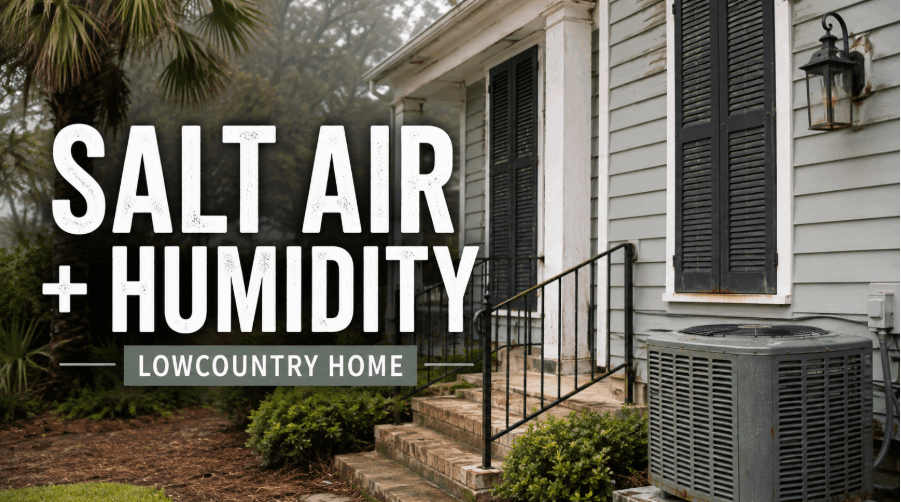
A Lowcountry home does not stop aging when the owner leaves. In some ways, it becomes more vulnerable because the three forces responsible for much of the quiet damage—salt, moisture and time—continue working while nobody is there to notice the first warning.
That is the part many second-home and seasonal owners underestimate. They prepare for hurricanes, lock the doors and adjust the thermostat, but the most expensive surprise may begin with something much smaller: a corroding HVAC component, a slow plumbing leak, a blocked condensate drain or indoor humidity that remains too high for too long.
The coastal environment does not always cause a dramatic failure overnight. It shortens the distance between routine maintenance and a costly repair.
Salt Air Attacks More Than Outdoor Furniture
Salt carried through coastal air settles on exposed metal. Once moisture is present, the combination of metal, salt and air creates the conditions for accelerated corrosion. FEMA warns that corrosion in coastal buildings can affect fasteners, connectors, rooftop equipment and other metal components, with unprotected steel deteriorating rapidly in salt air.
Around a Lowcountry home, that exposure can affect exterior door hardware, railings, light fixtures, screws, brackets, HVAC cabinets, condenser coils and the metal connections supporting decks, stairs and porches. Some deterioration is cosmetic. Other corrosion can weaken a component or cause equipment to fail earlier than an owner expected.
The problem is not limited to a house directly facing the ocean. The severity changes with distance from salt water, wind direction, humidity, equipment placement, protective coatings and whether the component is exposed or sheltered. A home that looks protected by trees or neighboring buildings can still have meaningful salt exposure.
Salt-air damage also tends to be uneven. One side of a home may show very little corrosion while the HVAC condenser, rear stair hardware or fasteners beneath a porch deteriorate faster. That makes property-specific inspection more useful than assuming every exterior component is aging at the same rate.
Humidity Does Its Damage From the Inside Out
Salt is easier to see because it leaves rust and surface deterioration. Humidity can be more deceptive. The house may look normal while moisture is collecting in closets, behind furniture, around supply vents, inside an HVAC system or beneath the floor.
The EPA recommends keeping indoor relative humidity below 60 percent, ideally between 30 and 50 percent when possible. High indoor humidity can create condensation and provide enough moisture for mold growth, especially around cold surfaces, HVAC components, carpets, drywall and poorly ventilated areas.
Mold is only one consequence. Wood naturally takes on and releases moisture as the temperature and relative humidity change. That moisture exchange affects the dimensional stability and performance of wood products. In a house, the visible results may include doors that stick, trim movement, cabinet swelling, wood-floor expansion or cupping, and deterioration of finishes or furnishings.
Leather, fabrics, rugs, upholstered furniture and stored clothing can also absorb moisture and develop mildew or persistent odors. A closed house may smell musty before an owner sees a clear source because humidity has affected multiple porous materials rather than one obvious wet area.
A home does not have to flood to develop a moisture problem. It only needs more moisture entering or being generated than the building and mechanical systems can remove.
Long Absences Remove the Early-Warning System
Leaving a home vacant does not create salt air or humidity. It removes response time.
When someone lives in the house, a dripping supply line may be heard. A warm room may reveal an HVAC problem. A ceiling stain may be noticed after heavy rain. A musty smell may prompt someone to check a closet or crawlspace.
When the property is empty, those signals can continue for days or weeks.
The EPA advises drying wet building materials within 24 to 48 hours because longer moisture exposure increases the risk of mold growth. A minor roof leak or plumbing failure that might have required a modest repair can therefore become a drywall, flooring, cabinet or remediation project when nobody finds it promptly.
University of Florida extension guidance for seasonal homes makes the same larger point: warm, humid environments make unoccupied properties more susceptible to mildew, corrosion, storm damage and other deterioration. Its recommendations include maintaining humidity control, servicing the air-conditioning system, checking condensate drainage and arranging for someone to inspect the home during an extended absence.
A long absence does not automatically damage the home. It gives a small problem more time to become an expensive one.
The Thermostat Number Is Not the Whole Plan
One of the most common mistakes is setting the thermostat high, closing the door and assuming the air conditioner will handle the rest.
An air-conditioning system controls temperature and removes moisture while it operates, but the thermostat usually responds to temperature rather than humidity. A home may therefore feel warm enough to trigger limited cooling while the indoor relative humidity remains too high.
Research from the Department of Energy's Building America program found that hot-humid homes may require supplemental dehumidification to consistently remain below 60 percent relative humidity. The correct setup depends on the home, HVAC design, air leakage, system sizing and how long the property will be vacant.
That makes a remote humidity monitor more useful than relying on a thermostat reading alone. Owners should be able to see whether the indoor humidity is rising, whether the HVAC system has stopped operating and whether a power or internet outage has interrupted monitoring.
The goal is not to keep an empty house unusually cold. The goal is to keep it dry enough that the building and furnishings remain stable.
Before an extended absence, the HVAC system should be operating correctly, the filter should be clean, the condensate line and drain pan should be clear, and any dehumidifier should have a reliable continuous drain. The exact temperature and humidity plan should be matched to the property instead of copied from another owner's house.
Water Becomes More Dangerous When Nobody Is Home
A running toilet, failed washing-machine hose, leaking water heater or slow plumbing connection can waste water and damage a house long before it becomes visible from outside.
Hilton Head Public Service District advises homeowners to know the location of their main shutoff valve and offers a water-usage portal that can provide alerts when unusual usage occurs during a vacation. The district also notes that leaks on the homeowner's side of the meter remain the owner's responsibility.
For some properties, shutting off the interior water supply during a long absence may reduce the exposure. That decision must account for irrigation, fire-protection systems, pool equipment, water-treatment systems, insurance requirements and the property's plumbing layout. A plumber or appropriate service professional should confirm which valves can safely be closed.
Remote leak sensors and automatic shutoff devices can shorten the time between a plumbing failure and the owner learning about it. They are not a substitute for maintenance, but they can prevent a slow leak from operating unnoticed for several weeks.
A Lowcountry Second Home Needs an Operating Plan
The ownership decision should include more than the purchase price, insurance payment and landscaping schedule. Someone also has to decide how the home will operate when it is empty.
That includes humidity monitoring, HVAC maintenance, leak detection, water management, storm inspections, pest observation and physical checks by someone who can enter the property. University of Florida extension guidance recommends arranging for a trusted person to inspect a seasonal home routinely rather than relying entirely on remote technology.
Technology can tell an owner that the temperature changed. It may not reveal a roof stain in the guest bedroom, corrosion around an exterior connection, a loose section of flashing, an overflowing HVAC drain pan or standing water beneath the house.
The strongest plan usually combines remote alerts with local eyes.
That matters when comparing a house with a condo. A condo association may handle some roofs, siding, landscaping, common structures or exterior insurance, but that does not eliminate the owner's exposure to interior plumbing, humidity, HVAC operation, windows, doors, furnishings and the financial consequences of building-wide repairs.
Buyers reviewing SECOND-HOME AND VACATION-CONDO OWNERSHIP should understand exactly where the association's responsibility ends and where the individual owner's responsibility begins.
Some Properties Are Easier to Leave Than Others
A larger house is not automatically harder to maintain, and a smaller property is not automatically simple. The easier property is usually the one with clearer maintenance responsibility, well-protected equipment, reliable drainage, healthy crawlspace or foundation conditions, accessible shutoffs and dependable local oversight.
Among HILTON HEAD HOMES, exposure can change significantly depending on proximity to salt water, elevation, tree coverage, foundation design, outdoor equipment location and how much of the property the owner must maintain directly.
The same ownership issue appears differently among BLUFFTON HOMES. Salt exposure may be lower in some mainland locations, but high humidity, heavy rain, crawlspace moisture, plumbing failures and long vacancies still require a plan.
That distinction matters for relocation and retirement buyers who expect to travel for part of the year. A home should be evaluated not only for how it works when the owner is present, but also for how confidently it can be managed when the owner is several states away.
Deferred Coastal Maintenance Becomes a Resale Problem
Salt and humidity damage rarely remain private ownership issues forever. They eventually show up when the property is inspected, photographed or shown to buyers.
A musty smell, corroded HVAC cabinet, rusted exterior hardware, stained vent, swollen door, damaged trim or warped flooring creates uncertainty. Buyers may not know whether they are seeing a small maintenance issue or evidence of a larger moisture problem.
That uncertainty usually affects confidence before it affects the repair estimate.
A seller preparing a seasonal or second home should correct the source rather than trying to hide the symptom. Painting over a stain, deodorizing a room or replacing one rusted fixture will not solve the concern if humidity remains uncontrolled or water is still entering the building.
Coastal property can age well, but only when maintenance keeps pace with the environment.
The Better Lowcountry Home Is the One You Can Manage
Salt air, humidity and long absences do not make Lowcountry ownership a bad decision. They change the standard by which the property should be evaluated.
The right home is not simply the one with the best view, largest porch or shortest drive to the beach. It also needs an ownership system that works when the house is occupied, when it is empty and when severe weather moves through the area.
Before buying, understand the materials, mechanical systems, drainage, association responsibilities, monitoring options and local support the property will require. Before leaving for an extended period, make sure the house can report a problem—and that somebody nearby can respond.
A Lowcountry home does not need constant attention. It does need consistent oversight.
Message me if you are comparing Hilton Head or Bluffton properties and want help understanding the ownership responsibilities behind the photos.
 Frequently Asked Questions
What indoor humidity level should a Lowcountry home maintain?
The EPA recommends indoor relative humidity below 60 percent and ideally between 30 and 50 percent when practical. In a hot, humid coastal environment, the actual equipment and settings needed to reach that range will depend on the home's construction, air leakage and HVAC system. A remote humidity monitor provides a better picture than temperature alone.
Should I turn off the air conditioning when leaving for several weeks?
Turning off the system can remove one of the home's main sources of moisture control. Seasonal-home guidance recommends continued air-conditioning operation during warm, humid conditions, with the property's temperature and humidity plan confirmed before departure. The system should also be serviced and its condensate drainage checked.
Does salt air only affect oceanfront homes?
No. Direct ocean exposure can be more severe, but corrosion depends on distance from salt water, wind direction, humidity, protective coatings, material choice and equipment placement. Homes without an ocean view can still experience meaningful coastal corrosion.
Is a condo easier to leave vacant than a house?
It can be, especially when the association handles substantial exterior maintenance. The owner must still understand responsibility for the HVAC system, plumbing, windows, doors, interior humidity, insurance deductibles and building-wide projects. The association reduces certain maintenance duties; it does not eliminate ownership risk.
How often should someone inspect an unoccupied home?
There is no schedule that fits every property. The frequency should reflect the home's systems, insurance requirements, season, storm activity and ability to send remote alerts. Inspections should also occur after significant weather or whenever a monitoring system reports an unusual condition.
Categories
- All Blogs (108)
- Hilton Head Condo Buyer Strategy (7)
- Beach Access & Coastal Ownership (1)
- Bluffton & Lowcountry Living (2)
- Bluffton Buyer / Seller / Comparison Topics (2)
- Bluffton Communities and Relocation (4)
- Bluffton Real Estate (8)
- Bluffton Real Estate / Relocation Guide (2)
- Buyer Advice (1)
- Buyer Guides (1)
- Costs, Fees, Insurance, Financing, and Due Diligence (1)
- Golf / Private Club / Gated Community Living (1)
- Golf / Private Club Communities (1)
- Hilton Head & Bluffton Buyer Strategy (1)
- Hilton Head Area Comparisons (1)
- Hilton Head Communities (4)
- Hilton Head Communities & Area Guides (11)
- Hilton Head Condo Buyer Guide (9)
- Hilton Head Condo Market Updates (1)
- Hilton Head Condo Seller Strategy (1)
- Hilton Head Condos & Villas (14)
- Hilton Head Homes (1)
- Hilton Head Homes + Island Living (2)
- Hilton Head Homes and Island Living (1)
- Hilton Head Real Estate (1)
- Hilton Head Seller Strategy (8)
- Hilton Head Short-Term Rental + Investment Guide (1)
- Hilton Head vs Bluffton (1)
- Hilton Head vs Bluffton / Relocation (3)
- Lowcountry Homeownership (1)
- Market Reports & Trends (4)
- Relocation and Retirement (1)
- Retirement & Relocation (1)
- Retirement and 55+ Communities (1)
- Retirement and Relocation (2)
- Retirement, 55+ & Private Club Living (3)
- Seller Strategy and Valuation (1)
- Short-Term Rentals & Investment (3)
Recent Posts