Why a Larger Bluffton House Is Not Always the Better Move
Why a Larger Bluffton House Is Not Always the Better Move
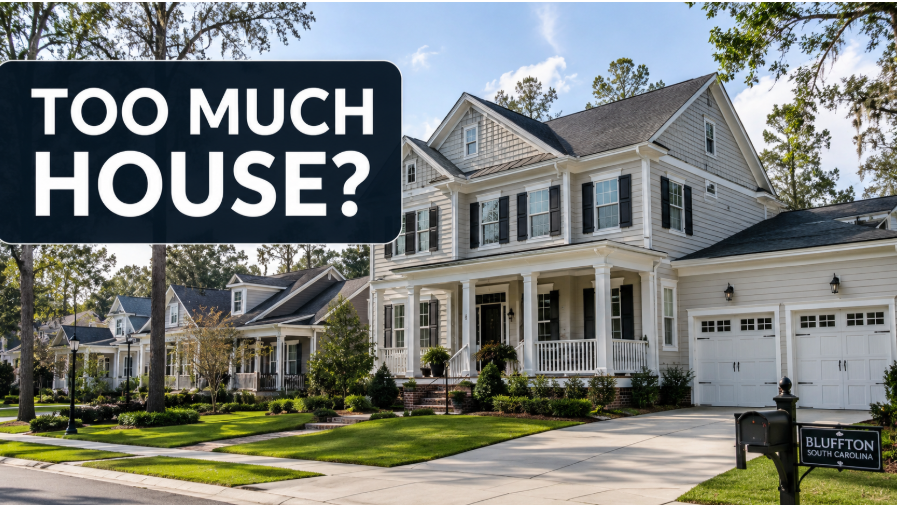
More square footage has a way of winning the home search before the buyer has decided what the extra space is supposed to accomplish.
A 3,000-square-foot house appears to beat a 2,200-square-foot house on paper. It may have another bedroom, an upstairs loft, a formal dining room, a larger primary suite, and a bathroom for nearly every guest who might someday visit.
Then the buyer lives there and discovers that several rooms rarely get used, the upstairs stays warmer than expected, the formal dining room becomes a place to stack boxes, and the extra bathroom still needs to be cleaned.
Square footage is easy to count. Daily usefulness is harder—and more important.
A larger Bluffton house can absolutely be the better purchase when the space solves a real need. It can make sense for a multigenerational household, two people working from home, frequent guests, a large family, serious hobbies, or a buyer who needs privacy between different parts of the home.
The mistake is assuming that more space automatically means a better house.
Bluffton Buyers Have Enough Choices to Look Beyond Square Footage
Bluffton is not a market where every buyer has to grab the first house with enough bedrooms.
In the 29910 ZIP code, Realtor.com reported 636 homes for sale as of June 2026, with active inventory up more than 36% from the prior year and a median market time of 65 days. The same report classified 29910 as a buyer's market for that month. That does not mean every desirable home will sit or that every seller will negotiate heavily. It does mean many buyers have enough selection to compare floor plans, communities, lots, condition, pricing, and ownership costs instead of choosing entirely by size.
When buyers have more options, extra square footage has to earn its place.
A larger home with an awkward layout, weak storage, an inconvenient location, dated systems, or a compromised lot may not be as useful as a smaller home that is better organized and better positioned.
Do not trade the right location, lot, condition, or floor plan for rooms you will keep closed.
A Larger House May Require Compromises Somewhere Else
Most buyers do not have an unlimited budget. Moving up in size usually means giving something else up.
That compromise could be the neighborhood, commute, condition, lot, garage, outdoor living area, renovation level, or monthly financial flexibility. A buyer may gain a fifth bedroom but move farther from work. Another may gain an upstairs bonus room but lose the screened porch, larger homesite, or first-floor primary suite that would have been used every day.
This matters in Bluffton because the home search can stretch across very different communities and ownership experiences. Buyers may be comparing newer construction with established neighborhoods, gated communities with lower-fee residential areas, or a larger house farther out with a smaller home closer to their normal routine.
The better house is not the one that wins the square-footage contest. It is the one that protects the parts of your budget and lifestyle you actually care about.
Buy for the Life You Live, Not Every Life You Can Imagine
Buyers frequently justify extra rooms with future possibilities.
The parents may eventually move in. Adult children may return home. Guests may visit for weeks. One spouse may start working remotely. A hobby might become a business. The upstairs loft could become a theater, gym, game room, or second office.
Some of those plans become real. Many do not.
Future flexibility is valuable only when the future is realistic enough to justify paying for it now.
A guest room that is used several times a month may be worth having. A separate office can be extremely valuable when someone works from home every day. A first-floor suite may solve a legitimate multigenerational need.
A formal living room, oversized loft, and two extra bedrooms that exist only for hypothetical situations are different. A room you use twice a year still costs money every month.
A Better Layout Can Outperform a Larger Floor Plan
Two homes with similar bedroom counts can live very differently.
A well-designed 2,200-square-foot home may have an open main living area, useful kitchen storage, a real office, a first-floor primary suite, generous closets, an attached garage, and a covered outdoor area. Nearly every part of the home contributes to daily life.
A 2,900-square-foot home may place much of its extra space in an oversized entry, formal rooms, wide hallways, an upstairs loft, or a primary bedroom sitting area that the owner rarely uses. The listing shows more square footage, but the smaller home may solve more problems.
Nationally, the median size of a new single-family home leveled off at approximately 2,155 square feet in 2025. Builders have also been emphasizing flexible rooms and multipurpose spaces rather than relying only on larger footprints. That shift reflects a broader affordability issue, but it also recognizes that useful space can matter more than raw size.
When touring a Bluffton home, pay attention to where the square footage is located.
A bonus room that works as an office, guest room, or exercise area may be more valuable than two highly specialized rooms. Good storage may eliminate the need for another bedroom. A screened porch may improve daily life more than an additional formal space inside.
Efficiency is not the same as being cramped. It means the house is working instead of merely being large.
The Extra Space Continues Costing Money After Closing
Buyers tend to notice the additional purchase price and mortgage payment first. The less obvious costs appear later.
More conditioned space can mean more energy use, although insulation, windows, HVAC efficiency, ceiling height, orientation, and household habits also affect the bill. Palmetto Electric's residential pricing is based on electricity consumption, so the practical concern is not square footage by itself. It is how much space must be cooled, how efficiently the home performs, and how the household uses it. The U.S. Department of Energy similarly treats building characteristics and efficiency as major drivers of residential energy consumption.
The same principle applies to maintenance.
More house can mean more flooring to replace, more walls to paint, more windows, more roof area, additional bathrooms, more furniture, and more spaces that eventually need attention. The cost may not arrive every month, but the surfaces and systems do not disappear because a room is rarely used.
Property taxes also should not be estimated by square footage alone. Beaufort County bases residential taxation on appraised value and the property's assessment classification. A qualifying primary residence is assessed at 4% of appraised value, while other residential property is generally assessed at 6%. The purchase price, market value, exemptions, and property use therefore matter more than simply comparing the size of two houses.
A larger house is not automatically unaffordable. It simply needs to be evaluated as a larger financial responsibility, not just a better deal because the price per square foot looks attractive.
More Space Can Reduce Financial Flexibility
A buyer may be approved for the larger home and still be better served by the smaller one.
There is a difference between qualifying for a payment and enjoying the life that payment leaves behind. The larger house may reduce money available for travel, retirement contributions, renovations, emergency reserves, furniture, landscaping, community fees, or the activities that motivated the move to Bluffton in the first place.
This is especially relevant for relocation and retirement buyers. A person may move to the Lowcountry for golf, boating, warmer weather, social activities, or easier access to Hilton Head. Buying the maximum house the lender approves can leave less room in the budget to enjoy those things.
The house should support the move. It should not consume the move.
Consider How the House Will Work Ten Years From Now
Large does not necessarily mean adaptable.
A larger two-story home may provide plenty of bedrooms but place the primary suite, laundry room, or most daily living upstairs. A somewhat smaller one-story home may be easier to navigate, maintain, and own long term.
That does not mean every buyer should avoid stairs. It means stairs, bedroom placement, bathroom access, doorway width, and the ability to live primarily on one floor deserve attention when the buyer expects to remain in the home for many years.
AARP's aging-in-place guidance identifies stairs, lighting, accessible pathways, bathroom configuration, and the ability to use a first-floor bedroom as important long-term considerations. Those details may matter more than whether one home has several hundred additional square feet.
A house can feel spacious today and become inconvenient later. Another can appear smaller online but continue working through several stages of life.
The goal is not predicting every future event. It is avoiding a floor plan that becomes difficult the moment normal life changes.
When the Larger Bluffton House Is the Better Choice
There are plenty of situations where buying more space is justified.
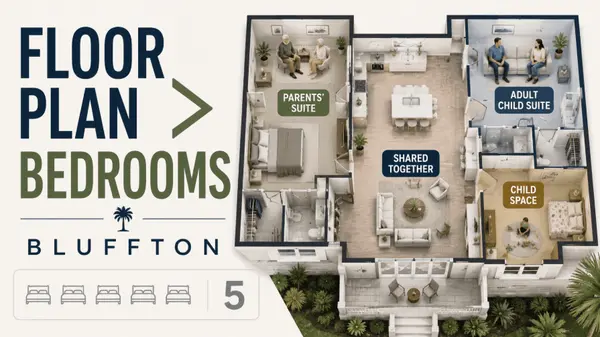
A larger household may need true bedroom separation. Two people working remotely may need offices that are not squeezed into bedrooms. A multigenerational family may benefit from a first-floor guest suite or separate living area. Buyers who host frequently may use the dining room, guest rooms, and outdoor entertaining space enough to justify them.
Some buyers also have hobbies that legitimately require space. A workshop, music room, fitness area, art studio, equipment storage room, or large garage can improve everyday life rather than create another unused room.
The larger home makes sense when the buyer can explain what the space will do, comfortably carry the full ownership cost, and avoid sacrificing higher priorities to obtain it.
There is nothing wrong with buying a large house because you enjoy space. The point is to make that choice consciously rather than assuming that the largest house within the budget must be the best value.
Use the Room Test Before Paying for More Space
Walk through the floor plan and give every room a job.
Do not settle for saying that a room could be useful someday. Decide who will use it, how often it will be used, and whether another room could perform the same function.
A guest room that doubles as an office may solve two needs. A loft may eliminate the need for a separate media room. Better garage storage may be more useful than another bedroom. A covered porch may provide more enjoyment than a formal living room.
When several rooms have no convincing purpose, the house may be larger than the life planned for it.
Use the Whole-Cost Test
Compare the complete ownership experience instead of only the sales price and square footage.
Look at the likely mortgage payment, property taxes, insurance, community fees, utilities, landscaping, immediate repairs, furnishing needs, and future maintenance. A newer or more efficient larger house may cost less to operate than an older smaller house with weak insulation and aging systems. The opposite can also be true.
The important part is getting estimates for the specific properties rather than relying on a broad assumption that bigger is always expensive or that smaller is always economical.
Use the Ten-Year Test
Think about how the home would perform through the most likely changes ahead.
Will children leave home? Could an aging parent move in? Will remote work continue? Is the buyer approaching retirement? Would a first-floor primary suite become important? Is the owner likely to travel frequently and prefer easier maintenance?
Buyers do not need a perfect ten-year prediction. They need a home that can handle probable changes without requiring them to pay indefinitely for unlikely ones.
Choose the Bluffton House That Solves the Right Problems
A successful home search is not about buying the least space possible. It is about buying enough useful space without allowing size to overpower everything else.
The right Bluffton house may be 1,800 square feet or 4,000 square feet. The number only becomes meaningful when it is connected to the layout, household, location, lot, condition, community, monthly cost, and long-term plan.
Start by comparing BLUFFTON HOMES in the communities and price ranges that make sense for your daily routine. Then build a PERSONALIZED HOME SEARCH around the rooms, storage, garage, outdoor space, and accessibility features you will actually use.
Message me if you are comparing Bluffton homes and want help separating useful space from square footage that simply looks impressive online.
 Frequently Asked Questions About Choosing the Right-Size Bluffton Home
How much square footage does a buyer really need?
There is no universal number. Start with the rooms the household will use daily or weekly, then add realistic guest, work, storage, hobby, and future needs. A well-designed smaller home can function better than a larger home with poorly allocated space.
Is a larger house always better for resale?
No. Larger homes may appeal to buyers who need more bedrooms or flexible space, but resale also depends on location, condition, floor plan, lot, garage, community, monthly cost, and price point. A smaller house with a stronger layout may attract a broader buyer pool than a large house with significant upkeep or inefficient space.
Will a larger Bluffton home always have higher property taxes?
Not automatically. Beaufort County property taxes depend on appraised value, the applicable assessment ratio, exemptions, and taxing district. A larger but lower-valued home could have a different tax result from a smaller home in a more expensive location. Buyers should review the estimated tax treatment for the specific property.
Should retirement buyers prioritize a one-story home?
A one-story layout can make long-term living easier, but it is not the only workable option. A two-story home may still perform well when the primary bedroom, full bathroom, laundry, kitchen, and main living area are on the first floor. The buyer should evaluate how much of the home can be used without relying on stairs.
When is paying for extra bedrooms worthwhile?
Extra bedrooms are useful when they support a clear need such as children, frequent visitors, home offices, multigenerational living, hobbies, or dedicated storage. They are less valuable when the buyer is paying for several rarely used rooms while compromising on location, condition, outdoor space, or financial flexibility.
Categories
- All Blogs (108)
- Hilton Head Condo Buyer Strategy (7)
- Beach Access & Coastal Ownership (1)
- Bluffton & Lowcountry Living (2)
- Bluffton Buyer / Seller / Comparison Topics (2)
- Bluffton Communities and Relocation (4)
- Bluffton Real Estate (8)
- Bluffton Real Estate / Relocation Guide (2)
- Buyer Advice (1)
- Buyer Guides (1)
- Costs, Fees, Insurance, Financing, and Due Diligence (1)
- Golf / Private Club / Gated Community Living (1)
- Golf / Private Club Communities (1)
- Hilton Head & Bluffton Buyer Strategy (1)
- Hilton Head Area Comparisons (1)
- Hilton Head Communities (4)
- Hilton Head Communities & Area Guides (11)
- Hilton Head Condo Buyer Guide (9)
- Hilton Head Condo Market Updates (1)
- Hilton Head Condo Seller Strategy (1)
- Hilton Head Condos & Villas (14)
- Hilton Head Homes (1)
- Hilton Head Homes + Island Living (2)
- Hilton Head Homes and Island Living (1)
- Hilton Head Real Estate (1)
- Hilton Head Seller Strategy (8)
- Hilton Head Short-Term Rental + Investment Guide (1)
- Hilton Head vs Bluffton (1)
- Hilton Head vs Bluffton / Relocation (3)
- Lowcountry Homeownership (1)
- Market Reports & Trends (4)
- Relocation and Retirement (1)
- Retirement & Relocation (1)
- Retirement and 55+ Communities (1)
- Retirement and Relocation (2)
- Retirement, 55+ & Private Club Living (3)
- Seller Strategy and Valuation (1)
- Short-Term Rentals & Investment (3)
Recent Posts